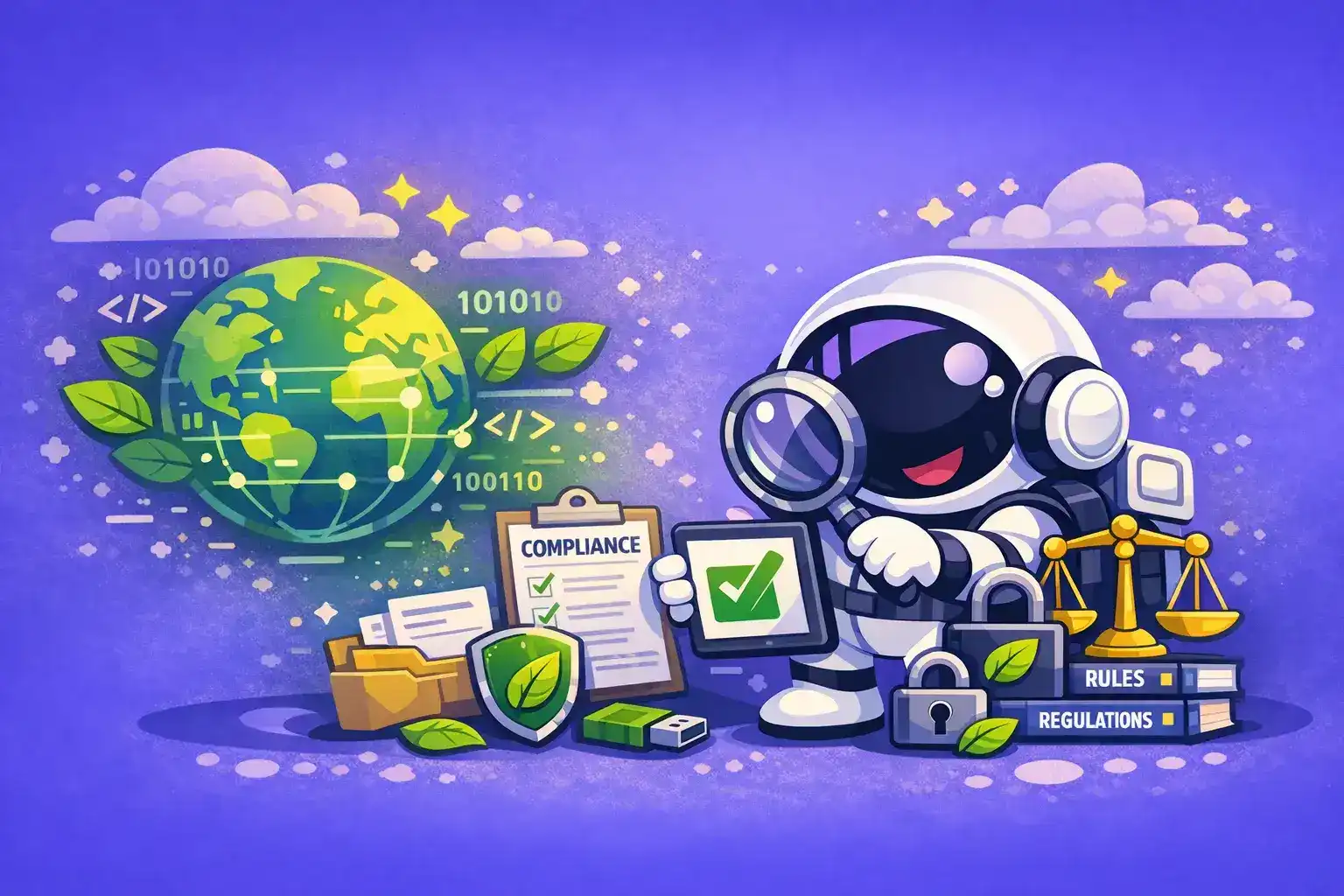

Navigating the New Reality of Green IT Compliance
For US executive teams, environmental accountability has officially moved from the marketing department to the IT budget. Historically, corporate sustainability initiatives focused heavily on physical supply chains and hardware energy consumption. Now, regulatory bodies and enterprise procurement committees are turning their scrutiny toward the digital realm, specifically targeting the carbon footprint of custom software. Mandates regarding Environmental, Social, and Governance (ESG) reporting are rapidly evolving into strict compliance frameworks. For a Chief Technology Officer or founder, ignoring this shift introduces severe operational liabilities, including potential regulatory fines and restricted access to lucrative corporate contracts.
The core metric driving this transformation is Software Carbon Intensity (SCI). This standard measures the rate of carbon emissions associated with a specific software application. It forces organizations to calculate not just the electricity powering their cloud servers, but the underlying efficiency of their proprietary code, the volume of their network data transfers, and their long-term storage strategies. When an enterprise application relies on bloated, legacy architecture, it inherently consumes more processing power and generates a massive, unquantifiable environmental footprint. This technical inefficiency is now a visible red flag for sophisticated B2B buyers who are mandated to clean up their own digital supply chains.
Consider a rapidly scaling US-based B2B SaaS provider attempting to close a contract with a Fortune 500 manufacturing firm. During the vendor assessment phase, the enterprise buyer requires an audited report detailing the SaaS platform's energy usage. Because the startup had never optimized its codebase for energy efficiency, it fails the procurement filter and loses a multi-million dollar deal. To prevent this, forward-thinking organizations must proactively engage with green IT standards. By treating software sustainability as a strict architectural requirement rather than an afterthought, businesses effectively mitigate regulatory risk and protect their revenue streams.
The Financial Argument for Sustainable Software Architecture
Transitioning to sustainable digital practices offers substantial financial advantages that extend far beyond simply avoiding compliance penalties. For decision-makers focused on protecting profit margins, the financial incentives are highly compelling. When development teams prioritize green engineering, they systematically strip away the computational waste that inflates monthly cloud hosting invoices. Bloated, unoptimized code forces servers to work harder, run longer, and consume vast amounts of expensive electricity. By refactoring these applications, organizations execute a massive reduction in their Total Cost of Ownership (TCO).
The mechanics of this financial recovery are rooted in lean engineering principles. Codyweb approaches sustainable software design by focusing on algorithmic efficiency and targeted resource allocation. We identify complex, redundant database queries that cause CPU spikes and replace them with streamlined, indexed operations. We also implement aggressive data caching strategies to minimize the repetitive processing of static information. Every kilobyte of data that does not need to be calculated or transferred represents a direct, measurable decrease in your monthly operating expenses. This technical frugality ensures that your capital is spent on supporting actual user growth rather than subsidizing inefficient infrastructure.
A pragmatic example involves a national logistics company operating a massive, monolithic tracking portal. Their servers were constantly over-provisioned to handle poorly written background scripts, leading to astronomical cloud computing costs. By partnering with a specialized engineering team to restructure their core application logic and eliminate redundant data processing, they slashed their server compute requirements by forty percent. This targeted optimization generated a massive Return on Investment (ROI) within the first quarter, proving that environmentally responsible coding directly correlates with elite corporate profitability.
Engineering Efficiency into the Software Development Lifecycle
To achieve lasting technical sustainability, green principles cannot be treated as a final checklist before product launch; they must be aggressively woven into every phase of the Software Development Lifecycle (SDLC). When environmental considerations are treated as an afterthought, companies are forced to execute expensive, time-consuming retrofits to meet new compliance standards. This reactive approach severely disrupts development schedules and delays the time-to-market for critical revenue-generating features. Proactive integration is the only way to build a resilient, future-proof platform.
During the initial architectural design phase, engineering leadership must prioritize sustainable patterns. This involves selecting modern, lightweight programming languages and designing database schemas that require minimal processing overhead. As the project moves into the active coding phase, developers must adhere to strict guidelines prioritizing computational efficiency. We utilize advanced integration tools within the CI/CD (Continuous Integration/Continuous Deployment) pipeline to automatically flag heavy, inefficient code patterns before they are ever pushed to the production environment. This automated oversight prevents technical debt from accumulating.
The testing phase is equally vital for enforcing these standards. Beyond standard functional and security testing, Quality Assurance (QA) teams must incorporate specific energy utilization metrics into their load testing protocols. By measuring the estimated carbon output of a specific user workflow under heavy traffic, we can isolate and resolve the most energy-intensive features. Take the case of a financial technology startup launching a new payment gateway. By embedding green SDLC practices from day one, they ensured their API calls were exceptionally lightweight. This rigorous engineering discipline allowed them to launch their product faster and confidently guarantee ultra-low processing overhead to their banking partners.
Optimizing Cloud Infrastructure and Data Management
The physical servers hosting your custom application represent the largest variable in your digital carbon footprint. Consequently, your infrastructure configuration and cloud strategy require meticulous optimization. Relying on static, dedicated servers that sit idle during off-peak hours is both financially wasteful and environmentally negligent. Modern sustainable architecture relies heavily on dynamic, auto-scaling environments that adjust compute resources in real-time based on actual user demand.
Migrating to serverless architectures or highly orchestrated containerization models provides massive efficiency gains. In a serverless environment, you only consume electricity and pay for compute power during the exact millisecond a function is executed. Furthermore, CTOs must actively evaluate the environmental commitments of their cloud hosting providers. Strategically routing your application traffic through data centers powered exclusively by verified renewable energy sources provides an immediate, massive reduction in your indirect carbon emissions without requiring a single change to your core codebase.
Intelligent data management is the final pillar of this infrastructure strategy. Hoarding obsolete user logs, uncompressed media files, and redundant database backups forces massive arrays of physical hard drives to spin continuously. Organizations must implement aggressive data lifecycle scripts that automatically archive stale records to low-energy cold storage and permanently delete unnecessary files. A US-based corporate healthcare provider recently executed this strategy, purging terabytes of redundant interaction logs from their active databases. This action not only dramatically lowered their environmental footprint but also accelerated their primary portal's response times, significantly improving the end-user experience.
Transforming Environmental Compliance into a Lead Generation Asset
In a highly saturated B2B market, achieving strict environmental compliance is not just a defensive maneuver; it is a highly aggressive tool for market differentiation. Enterprise buyers, government agencies, and institutional investors are actively seeking software vendors who can help them achieve their own corporate sustainability goals. When you can mathematically prove that your custom software operates with maximum energy efficiency, you possess a unique, compelling value proposition that easily cuts through standard marketing noise.
For marketing directors and sales executives, verified energy consumption metrics serve as a powerful narrative for lead generation. Instead of relying on generic claims about software speed or usability, your sales team can present prospects with concrete data demonstrating how switching to your platform will actively reduce their Scope 3 carbon emissions. This transparent, data-driven approach instantly elevates your brand reputation and establishes your organization as a mature, responsible industry leader.
Consider a B2B procurement software vendor competing against massive, entrenched legacy platforms. By utilizing a highly optimized, serverless architecture, their compute footprint was a tiny fraction of their older competitors. They exposed this data through a custom client dashboard, allowing prospective buyers to calculate the immediate reduction in their supply chain emissions simply by switching vendors. This powerful differentiator allowed them to bypass traditional feature comparisons and secure highly lucrative contracts with eco-conscious Fortune 500 corporations, proving that green engineering directly accelerates B2B sales cycles.
Securing Long-Term Corporate Viability Through Agile Engineering
Preparing your digital infrastructure for the incoming wave of environmental regulations is a foundational requirement for securing long-term market dominance. The regulatory requirements governing digital services are becoming stricter every quarter. Enterprises that refuse to modernize their legacy codebases will soon find themselves entirely locked out of major corporate procurement pipelines due to non-compliance. By embracing sustainable software development today, you build inherent agility into your corporate systems, ensuring you can adapt to new mandates instantly.
This commitment to technical excellence forces your engineering teams to abandon lazy development habits and prioritize raw efficiency. Optimized code, intelligent cloud scaling, and ruthless data management naturally eradicate technical debt. This results in an incredibly stable, highly secure software platform that rarely crashes and requires minimal maintenance overhead. Your IT department is freed from constant firefighting, allowing them to focus entirely on building innovative features that drive new revenue.
At Codyweb, we specialize in architecting these high-performance, compliant digital assets. We engineer custom B2B web applications that operate flawlessly under immense pressure while minimizing computational waste at every level of the stack. Do not allow bloated, inefficient software to threaten your corporate growth or inflate your operating expenses. Partner with a specialized engineering firm to restructure your digital portfolio, ensure strict environmental compliance, and deploy a dominant platform tailored exactly to your aggressive commercial objectives.
- vote(s)