Quote

Web eco-design speeds up your tools and strengthens your SEO

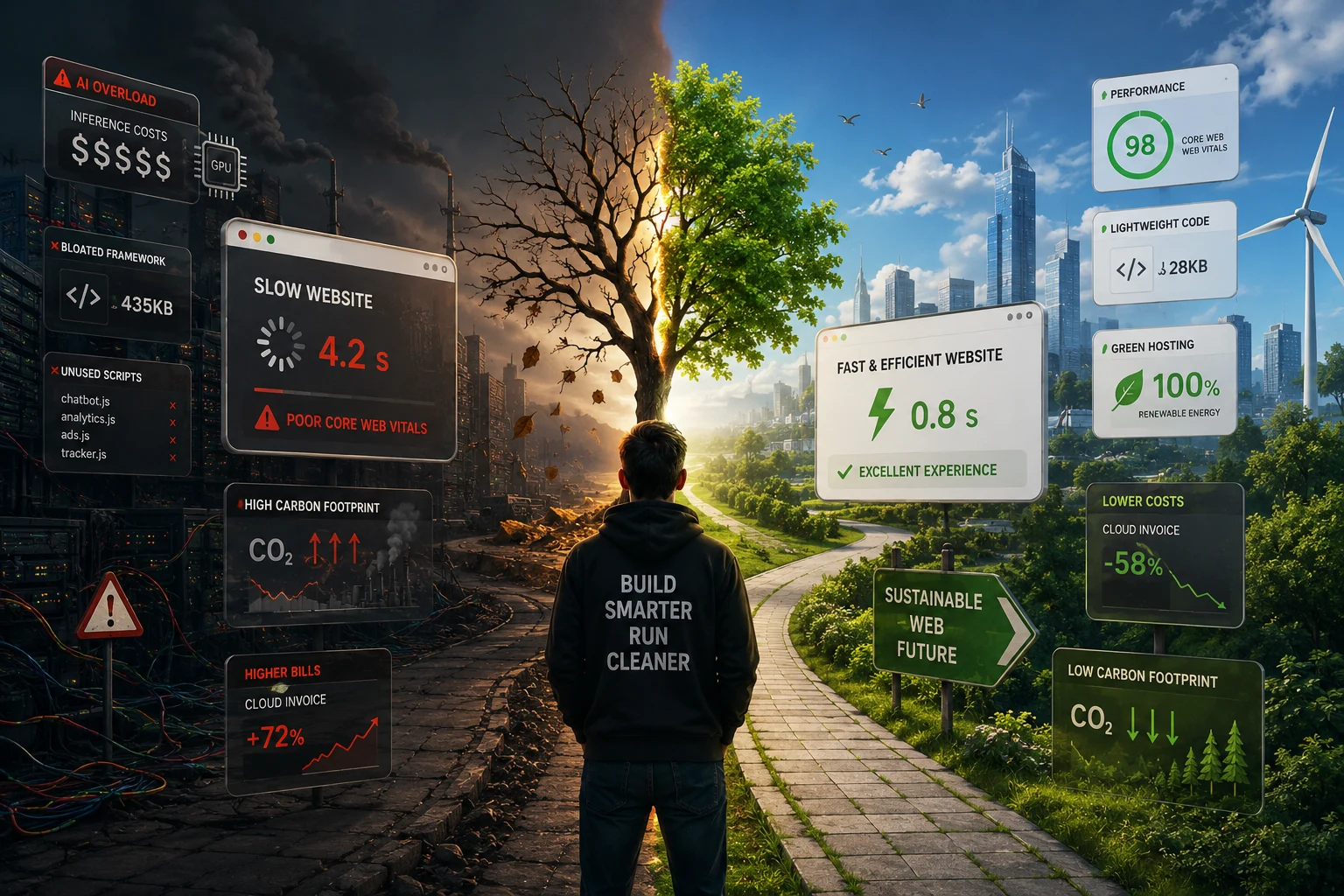
On the web, slowness is expensive. If your site takes more than 3 seconds to load, more than half of your visitors leave for a competitor, and you lose business opportunities before you have even had the chance to present your offer.

A heavy site loads slowly and loses its visitors before the first page appears, and Google penalizes it in its rankings. Web eco-design addresses this problem at its source.

We deliver eco-designed websites and applications free of technical overhead. They load quickly on desktop and mobile alike and climb in search results, so your visitors stay and take action.

  • Codyweb is rated 5 out of 5 on Google

    | 79 Google reviews

  • Footprint measured with EcoIndex
  • Green hosting
Software engineering and technical web eco-design

Our method

Digital sobriety as a performance engine

Visibility is never left to chance. We apply a strict technical protocol so that every page published on your site is immediately understood and valued by Google.

The technical choice

How an overloaded architecture holds back your growth

A site built on a general-purpose platform carries hundreds of features and scripts that your business will never use. This technical debt weighs down every page, slows rendering on your prospects' smartphones and puts needless strain on your hosting. Google takes all of this into account in its rankings.

With a custom architecture, your site carries only the features and content that produce results for your company.

Loading speed optimization and technical debt reduction

What you gain

A measurable return on investment

Investing in eco-design brings you concrete business benefits:

  • You climb in Google results (SEO): Google measures the loading speed (LCP), responsiveness (INP) and visual stability (CLS) of your pages, known as the Core Web Vitals, and favors light, fast sites. This is a direct advantage for your rankings in search engines.

  • You maximize your conversions: by eliminating loading delays, you hold your visitors' attention and mechanically increase the volume of quote requests or sales.

  • You enhance your corporate image (CSR): we can measure your site's environmental footprint with EcoIndex, an open scoring method for web pages. Being able to prove that you meet strict standards is a significant advantage when competing for tenders.

  • You broaden your market: a light site stays smooth on a four-year-old smartphone or in areas with weak coverage (3G). Your services are open to 100% of your target audience, with no one left out.

80% of digital pollution comes from manufacturing devices. A heavy site pushes users to replace their phone or abandon their visit, so fighting obsolescence is an ecological act and, above all, a way to avoid losing a single prospect.

Smooth site performance on older devices

FAQ

Pragmatic answers about our eco-design method

Your questions about a custom web project

Demystifying eco-design

Eco-design raises questions, particularly about design and budget. We answer them here, plainly.

Do you have other questions?

Ask us
  • What does web eco-design mean in practice?

    Web eco-design reduces the resources a page consumes (code volume, number of requests, data transferred) without removing anything that serves the visitor. The approach covers user journey design, development, media and hosting. It is measured with public indicators: the EcoIndex score and Google's Core Web Vitals.

  • Will my site look less attractive or too basic?

    Not at all. Eco-design places no limits on your visual identity or the quality of your design. The real difference is invisible to your customers, because it lies in the site's "engine": we replace heavy modules with optimized custom code. Your visitors enjoy a high-end visual experience that loads at lightning speed.

  • Will this method increase my development budget?

    On the contrary, it rationalizes your spending. By applying the principle of "functional sobriety", we develop only the features that genuinely serve your business. There are no overpriced, overbuilt systems: your budget is invested in pure efficiency. In addition, a leaner architecture will cost you far less to maintain over the long term.

  • What if my company has no stated environmental commitment?

    Set ecology aside for a moment: you need visibility on Google and prospects who complete their journey on your site. Eco-design is the most powerful technical tool for reaching both of these profitability goals. Whether or not you are committed to an environmental approach, it is first and foremost a winning business strategy.

  • Can an existing site be eco-designed without rebuilding it?

    Partly. Images, third-party scripts, fonts and hosting can be optimized without touching the structure, and the initial audit quantifies the potential gain. The weight that comes from the architecture itself, such as unused features and stacked modules, can only be fixed through a redesign. The audit determines which of the two scenarios applies to your site.

  • How can you check whether a site is eco-designed?

    Three public measurements are enough for an initial assessment: the page's EcoIndex score, its Core Web Vitals in PageSpeed Insights, and the total weight transferred, which is visible in the browser's developer tools. We explore these measurements further in our articles on sustainable web design.

Contact

Got a project in mind?

Website, business application or redesign: we offer a free scoping call to assess your needs and send you an estimate within 48 hours.

Launch your web project with Codyweb

Our expertise

Explore our other areas of expertise

We build, optimize for search and maintain your project so that it stays fast, secure and visible over time.

Our services

Everything is custom-built, around your business

As a custom web development agency, we handle every project from website design to SEO strategy, including custom applications. Most of our projects combine two or three.

Taking optimization further

Find out in our publications how to reduce your digital footprint while improving performance.

It looks like your browser is in English. Switch to English?