
The Hidden Financial Drain of Monolithic Legacy Systems
For many US enterprises, the core technology infrastructure driving daily operations has slowly morphed into a massive liability. Historically, organizations developed large, heavily integrated monolithic applications where the user interface, business logic, and database layers were tightly fused together. While this approach seemed efficient during initial development, it creates severe structural bottlenecks as the company attempts to scale. Decision-makers, from CTOs evaluating technical debt to CMOs pushing for rapid campaign launches, frequently encounter a frustrating reality: making a minor update to a frontend customer portal requires untangling millions of lines of backend code. This extreme rigidity paralyzes innovation and significantly inflates operational expenses.
The friction inherent in tightly coupled systems directly impacts an organization’s ability to compete in aggressive markets. When marketing and product teams identify a new opportunity for lead generation, they are often told by the IT department that the required digital tools will take six to nine months to deploy. This internal latency means missing critical market windows and allowing more agile competitors to capture market share. Furthermore, because the entire monolithic application must be tested and deployed as a single unit, the risk of a catastrophic system failure during an update is exceptionally high. A bug in a secondary reporting module can easily crash the primary checkout process, resulting in immediate revenue loss and severe brand damage.
Beyond the lost opportunities, maintaining these legacy structures continuously drives up the Total Cost of Ownership (TCO). Engineering teams spend the vast majority of their expensive labor hours simply maintaining the status quo, fighting fires, and executing complex regression tests rather than building proprietary features that add business value. Recognizing this unsustainable financial drain is the first step toward modernization. Escaping this cycle requires a fundamental shift away from isolated software applications and toward a modular, decoupled digital ecosystem that prioritizes data exchange above all else.
Decoding Custom API-First Architecture for the Enterprise
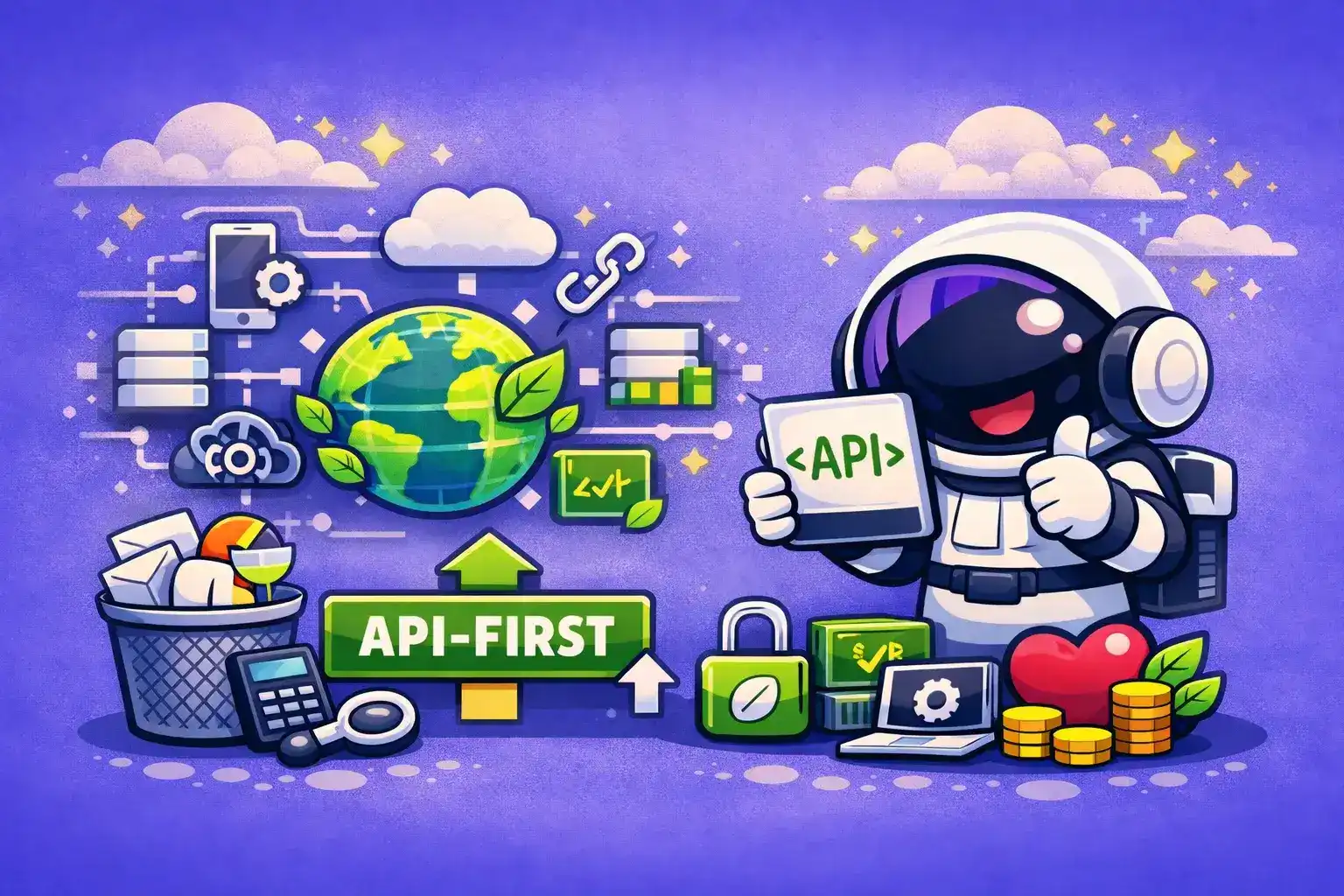
Modernizing an enterprise technology stack requires more than just migrating old code to a cloud server; it demands a complete architectural paradigm shift. A custom API-first architecture fundamentally redefines how software is conceptualized and engineered. Instead of building an application and treating the Application Programming Interface (API) as an afterthought to be bolted on later, the API is designed, documented, and rigorously tested before a single line of frontend code is written. The API contract becomes the foundational blueprint for the entire organization, dictating exactly how different software components will interact and share data.
At Codyweb, our engineering methodology centers on constructing these highly secure, autonomous digital building blocks. We engineer discrete microservices—such as a dedicated payment processing engine, a user authentication module, or a dynamic pricing calculator—that operate independently and communicate exclusively through standardized protocols like REST or GraphQL. This separation of concerns means that the backend logic is completely decoupled from the frontend presentation layer. A mobile application, a B2B web portal, and an internal administrative dashboard can all consume the exact same backend data simultaneously without interfering with one another.
Consider a large US manufacturing firm attempting to modernize its supply chain operations. In a traditional setup, connecting their legacy ERP system to a new partner portal and a third-party logistics provider would require brittle, point-to-point custom integrations that break constantly. By partnering with us to deploy an API-first framework, the manufacturer establishes a central data routing hub. The ERP exposes inventory data via a secure API, which the partner portal and the logistics vendor can independently consume. This standardized, contract-based communication eliminates integration headaches, ensures absolute data consistency, and drastically accelerates the onboarding of new business partners.
Accelerating Time-to-Market With Modular Engineering
In highly competitive B2B sectors, operational velocity is the ultimate differentiator. The ability to launch new digital products, enter new markets, or release highly requested features quickly directly dictates corporate growth. A custom API-first approach serves as a massive accelerator for your time-to-market. Because the architecture relies on independent, modular services, different engineering squads can work in parallel without blocking each other. The frontend development team can build the user interface using mock API data while the backend team simultaneously codes the database logic.
This concurrent development model shatters traditional bottlenecks. When a company needs to launch a new mobile application to complement its existing web dashboard, developers do not need to rewrite the core business logic. They simply construct the new mobile interface and connect it to the exact same APIs that currently power the website. This reusability of code treats your internal software services like proprietary Lego blocks, allowing your IT department to assemble new digital solutions in a fraction of the time it would take to build them from scratch.
Take the example of a fast-growing financial technology startup expanding its services. When the marketing department demands a new automated onboarding flow to improve conversion rates, the engineering team leverages existing identity verification and document parsing APIs. They rapidly construct the new frontend flow and push it to production in weeks rather than quarters. This extreme agility ensures that the enterprise can react instantly to shifting customer expectations, launch targeted acquisition campaigns faster, and consistently outmaneuver competitors who are still suffocating under the weight of monolithic deployment cycles.
Driving Down TCO and Optimizing Infrastructure ROI
While executive leadership might view a major architectural overhaul as a significant capital expenditure, an API-first strategy is fundamentally a cost-reduction mechanism over the long term. The financial benefits manifest clearly in the drastic reduction of your ongoing operational expenses. In a decoupled environment, maintaining and upgrading the system becomes highly efficient. If the third-party email notification service needs to be replaced, developers simply update the specific API endpoint. The rest of the enterprise application remains entirely untouched, eliminating the need for massive, system-wide regression testing.
Furthermore, this modularity allows for pinpoint infrastructure scaling, which drastically optimizes your cloud computing budget. In a traditional monolith, if a specific feature—like a monthly financial reporting tool—experiences heavy usage, the IT department must provision expensive servers to duplicate the entire application. With a custom API-first build, Codyweb engineers ensure that only the specific service under load scales up. If the reporting API is heavily taxed at the end of the month, only that isolated service receives additional compute resources. This precise resource allocation prevents the financial waste of over-provisioning and maximizes the Return on Investment (ROI) of your cloud hosting expenditures.
The reduction in technical debt also yields massive savings in human capital. Because API contracts are clearly defined and strictly enforced, onboarding new developers becomes significantly faster. They do not need to understand the entire labyrinth of the corporate codebase; they only need to understand the inputs and outputs of the specific API they are working on. By stripping away structural complexity, your highly compensated engineering talent spends less time debugging legacy conflicts and more time writing features that actively generate revenue for the business.
Unlocking Omnichannel Experiences and New Revenue Streams
For CMOs and sales directors, the internal technical architecture directly dictates the external customer experience. Modern B2B buyers expect to interact with your brand across multiple touchpoints—desktop portals, mobile devices, automated CRM integrations, and even smartwatch notifications. Delivering a consistent, personalized journey across these distinct channels is technically impossible if your data is trapped within siloed monolithic applications. An API-first foundation breaks down these walls, allowing a single source of truth to feed data to any device or external platform instantly.
This unified data layer is the absolute prerequisite for effective, modern marketing automation. When every touchpoint communicates via the same core APIs, marketing teams gain a comprehensive, real-time view of user behavior. If a prospect configures a complex pricing quote on their mobile phone during a commute, that exact configuration is instantly available when they log into the desktop portal at their office. This frictionless transition significantly boosts user satisfaction, accelerates the sales cycle, and serves as a powerful engine for high-quality lead generation.
Beyond optimizing current operations, exposing your proprietary business logic via secure APIs opens the door to entirely new revenue streams. By treating your APIs as commercial products, you can empower third-party developers, strategic partners, and even clients to build their own custom applications on top of your infrastructure. Consider a logistics software provider that monetizes its route-optimization algorithm by offering it as a paid API to other fleet management companies. This creates a thriving digital ecosystem around your brand, driving indirect sales channels and establishing your enterprise as an indispensable platform within your industry.
Future-Proofing the Technology Stack for Sustained Growth
The most severe risk an enterprise faces is technological obsolescence. The digital environment is incredibly volatile, with artificial intelligence, advanced machine learning models, and sophisticated IoT networks becoming standard business requirements. Monolithic systems cannot adapt to these rapid advancements without undergoing disruptive, multi-million-dollar rebuilds. A custom API-first architecture, however, is inherently designed for continuous evolution. It provides a flexible, resilient foundation that accommodates future technologies without breaking existing workflows.
This architectural independence acts as the ultimate defense against vendor lock-in. Because your frontend interfaces and backend databases communicate through standardized API contracts, you retain the freedom to swap out underlying technologies as needed. If a legacy CRM vendor aggressively raises their licensing fees, you can migrate to a new CRM provider behind the scenes. As long as the new system honors the existing API contract, your client-facing portals and internal dashboards will continue to function normally. You maintain absolute control over your technology roadmap.
For founders and executive leadership, partnering with Codyweb to implement an API-first strategy represents a commitment to sustained market dominance. We build the secure, scalable, and modular digital infrastructure required to execute your most ambitious corporate objectives. By decoupling your business logic from presentation layers, you guarantee that your organization remains agile, your operational costs remain low, and your technology investments continue to yield high returns regardless of how the market shifts in the future.
- vote(s)