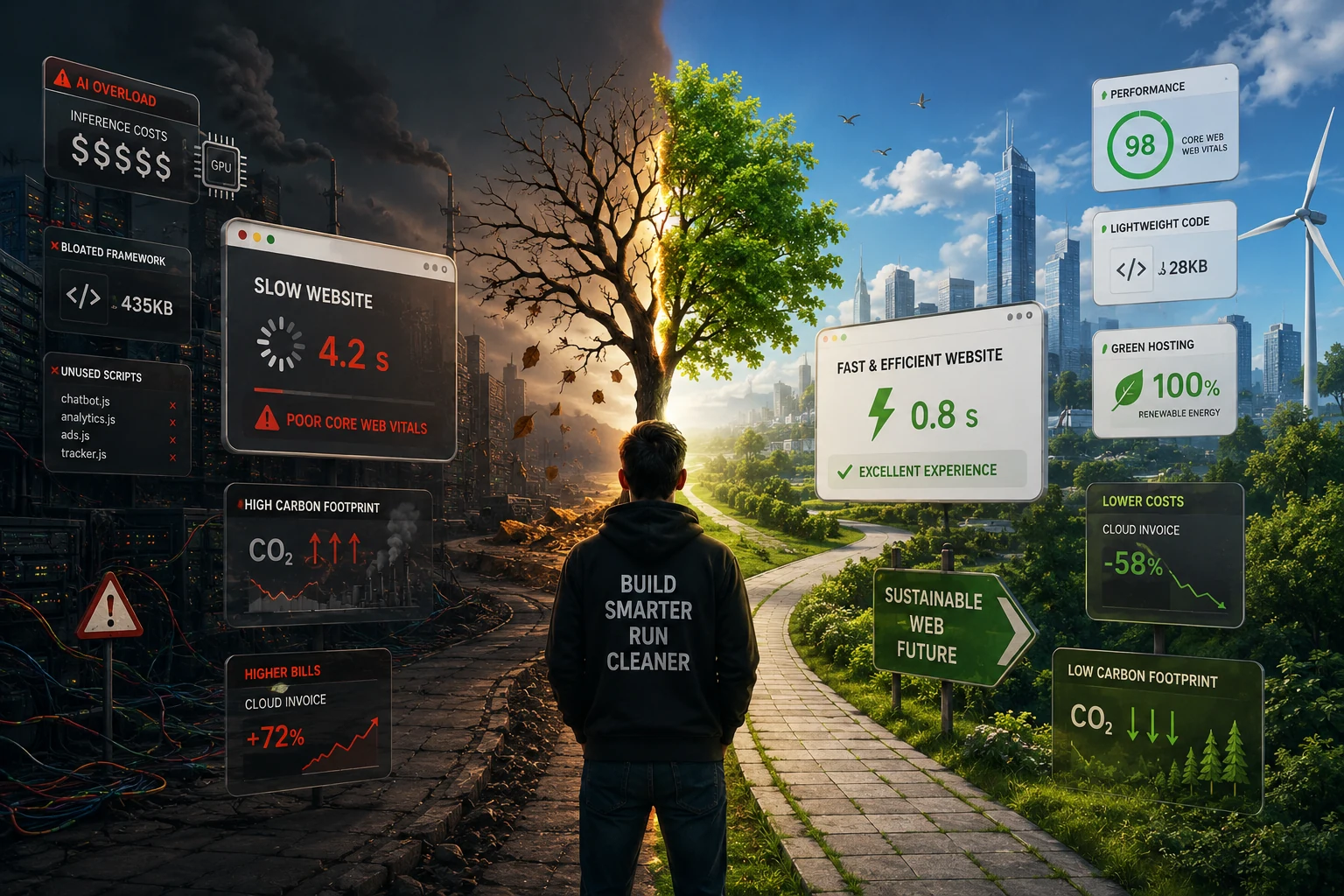

Why your AI-heavy website is becoming a financial and regulatory liability
American companies are waking up to a new reality: the websites and digital products they built over the last three years are quietly burning electricity at a scale nobody planned for. Every embedded AI feature, every generative widget, every "smart" search bar consumes inference cycles that translate directly into kilowatt-hours and dollars on the next utility bill.
For CTOs and CMOs running B2B platforms, the problem is no longer theoretical. Data center power consumption in the United States has doubled since 2022, and Virginia alone now dedicates roughly a quarter of its electricity supply to server farms. The cost is passed back to clients through cloud invoices, third-party API pricing, and the steady inflation of every SaaS subscription tied to generative features.
The regulatory pressure has caught up too. California's SB 53 disclosure mandate now requires companies to report the carbon intensity of AI workloads, and similar bills are working through state legislatures from New York to Washington. Investors are asking the same questions during due diligence. A website that cannot document its energy profile is becoming a liability on the balance sheet, not just an engineering concern.
The hidden cost of bloated frameworks and AI-powered everything
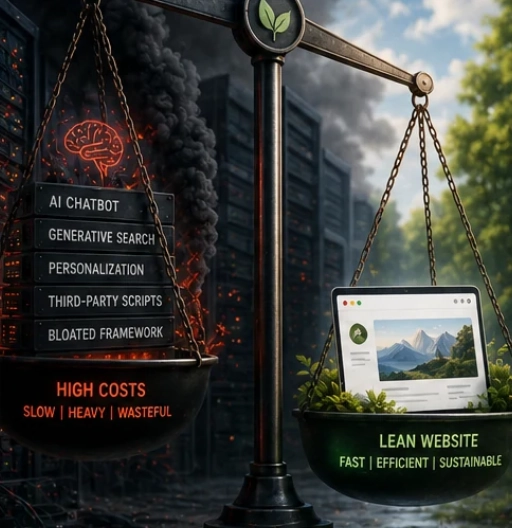
Most modern web stacks were designed for developer convenience, not for energy efficiency. A typical corporate site today ships with a meta-framework, a headless CMS, three analytics scripts, an AI chatbot, two personalization engines, and a generative search tool. Each of these calls back to a third-party server, often running on GPU infrastructure that consumes ten to forty times more power than traditional CPU workloads.
The result is a website that loads slowly on the user side and bleeds money on the server side. Vibe coding and AI-assisted scaffolding accelerate this trend by producing applications that work but carry massive amounts of unused dependencies, redundant API calls, and oversized JavaScript bundles. Developers ship faster, but the operational footprint grows in parallel.
The business impact compounds over time. Higher cloud bills eat into margins. Slow page speeds reduce conversion rates and damage organic search rankings, since Google now weighs Core Web Vitals heavily in its ranking algorithms. Customer support teams field complaints about laggy interfaces. And finance departments suddenly have to answer board-level questions about Scope 2 emissions tied to digital infrastructure.
This is not a problem that more AI will solve. It is a problem caused by treating AI as a default ingredient instead of a deliberate choice.
What sustainable web development actually means in 2026
Sustainable web development is the practice of building digital products that deliver business outcomes with the smallest possible energy footprint. It is not a marketing label. It is a measurable engineering discipline that touches code quality, hosting choices, asset optimization, and the architecture of every feature shipped to production.
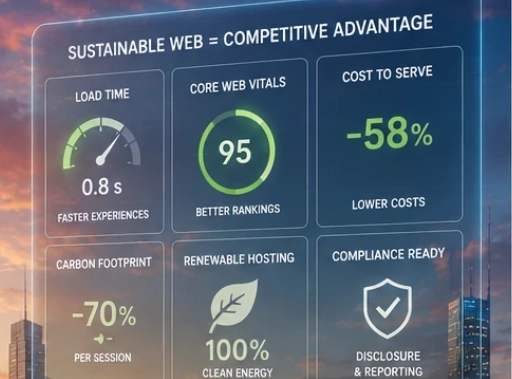
The core principle is brutally simple: every line of code, every database query, every API request consumes electricity somewhere. Reducing waste at each layer compounds into significant savings. A page that loads in 800 milliseconds instead of four seconds is not just faster for the user, it is cheaper to serve, ranks better in search, and produces a fraction of the carbon emissions per session.
For B2B companies serving the American market, this means rethinking the default stack. Do you actually need a JavaScript framework that ships 400 kilobytes of runtime to render a static page? Does your contact form require a generative AI layer, or would a properly engineered native form do the same job at one percent of the cost? These questions used to be philosophical. In 2026, they are budget decisions.
The companies that ask them honestly are pulling ahead. They report lower hosting bills, faster time to market on new features, and a documentation trail that satisfies the new disclosure rules without scrambling.
Custom-coded websites: the underrated answer to a very modern problem
The return of custom-coded websites is one of the quieter shifts happening in the American B2B landscape right now. Agencies that build from scratch, using lean server-side languages and native databases, are producing sites that consume a fraction of the resources of equivalent CMS-based or framework-heavy alternatives.
The mechanics are straightforward. A site built without a bloated CMS does not load hundreds of plugins on every request. A page rendered server-side with optimized SQL queries does not require a JavaScript runtime to display content. An image pipeline that serves correctly sized WebP files through responsive markup does not waste bandwidth on devices that will never display the full resolution. Each decision saves milliseconds and watts.
For a mid-sized SaaS company or an e-commerce platform doing several million sessions a month, the difference adds up quickly. We have seen cases where switching from a heavy headless setup to a custom PHP and MySQL architecture reduced server costs by sixty percent while improving Lighthouse scores into the high nineties. The same site also became eligible for green hosting certifications that customers increasingly ask about during procurement.
The catch is that custom development requires actual engineering skill. It cannot be vibe-coded. It demands an agency that understands database design, caching strategies, and the discipline of shipping only what the product genuinely needs. The upfront investment is higher than buying a template. The five-year cost of ownership is dramatically lower.
Concrete steps American businesses can take this quarter
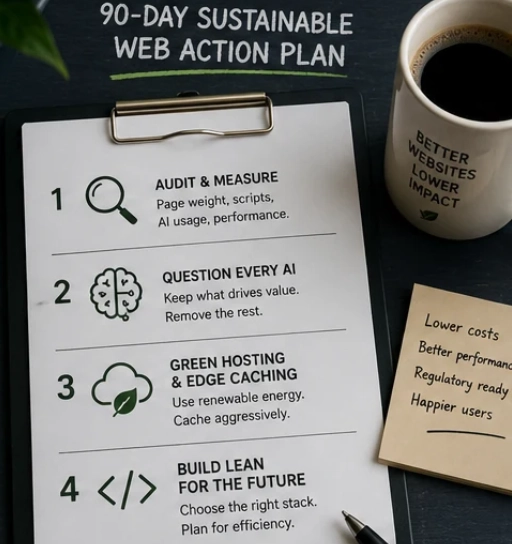
Most companies cannot rewrite their entire digital stack overnight. They can, however, take a series of measurable actions over the next ninety days that will reduce energy consumption, improve performance, and build a defensible position against incoming disclosure requirements.
The first step is an honest audit. Measure the page weight of your top ten landing pages, the number of third-party scripts loaded, the size of your JavaScript bundles, and the actual usage rate of every AI feature embedded in your product. Most audits reveal that thirty to fifty percent of loaded resources are never used by the visitor on a given session. That is pure waste.
The second step is to question every AI integration. For each one, ask whether it produces measurable business value that justifies its cost. A generative chatbot that handles ten percent of support tickets is a clear win. A "smart" homepage banner that personalizes greetings using a large language model is almost certainly not. Removing the second category alone can cut inference costs by significant margins.
The third step is to invest in green hosting and edge caching. Hosting providers that run on renewable energy, combined with aggressive CDN caching, reduce the carbon footprint of every page view without changing a line of application code. This is the lowest-hanging fruit available right now.
The fourth step is to plan for the next major site iteration with sustainability as a first-class requirement, not an afterthought. That means choosing technologies, agencies, and architectures that will produce a lean codebase capable of running efficiently for the next five to seven years.
What the next eighteen months will demand from American tech leaders
The trajectory is clear. Energy costs will keep rising. Disclosure rules will keep expanding from California to other states and eventually to federal level. Customers, investors, and procurement departments will increasingly ask companies to prove that their digital operations are not part of the problem.
Tech leaders who treat this shift as a constraint will fall behind. Those who treat it as a competitive advantage will pull ahead. A fast, lean, custom-built website that documents its energy profile sends a clear signal to enterprise buyers: this is a company that knows what it is doing, both technically and financially.
The opportunity is also commercial. American B2B buyers are starting to factor sustainability into vendor selection. A digital product that loads in under a second, scores ninety-five on Core Web Vitals, and ships with a transparent carbon report will close deals that a slower, heavier competitor cannot.
This is not about virtue signaling. It is about building digital products that are cheaper to run, faster to use, easier to defend in front of regulators, and more attractive to the decision-makers who sign the checks.
Build a website that works for your business and the grid
If your current site loads slowly, costs too much to operate, or relies on AI features that nobody actually uses, the next twelve months are the right window to fix it. Waiting until disclosure rules become federal or until cloud bills become unbearable is the more expensive path.
A custom-built, lean performance-first website is not a luxury. In 2026, it is the most rational option for any American B2B company that wants to control costs, satisfy upcoming regulations, and deliver a digital experience that converts. Talk to an agency that builds from scratch, asks hard questions about every feature, and can document the energy profile of what they ship. Your CFO, your CMO, and your customers will all notice the difference.
- vote(s)