
The Hidden Financial Toll of Opaque Development Cycles
For US enterprise decision-makers—CTOs, CMOs, and founders—authorizing a custom software build often feels like handing over a blank check to a black box. Traditional development models frequently lack the granular visibility required to track how capital is being converted into functional logic. This opacity is not merely a communication issue; it is a direct contributor to an inflating Total Cost of Ownership (TCO). When leadership cannot see the incremental progress of a build, minor misalignments in business requirements go undetected for months. By the time these errors surface, the cost of remediation is exponential, leading to catastrophic budget overruns and a severely deferred Return on Investment (ROI).
The frustration for B2B executives often stems from a lack of accountability in the engineering process. Without real-time insights into resource allocation and sprint velocity, technical debt can accumulate unnoticed, eventually paralyzing the application's performance. Our approach at Codyweb dismantles this dynamic by treating software development as a transparent financial and strategic operation. We provide the unvarnished data required to make informed decisions, ensuring that every dollar spent is actively building a competitive advantage rather than subsidizing inefficient workflows or redundant code.
Consider a mid-market financial services firm attempting to launch a proprietary client portal. Under a traditional "waterfall" vendor, the firm might wait six months for a grand reveal, only to find the security protocols don't meet their specific compliance mandates. The resulting rework could double the project's cost and delay market entry by a year. By contrast, a transparent framework exposes these architectural decisions as they happen, allowing for instant course correction. This proactive visibility ensures that the final product arrives ready to generate revenue, protecting your capital and securing a faster path to profitability.
Lowering TCO Through Fixed-Phase Pricing and Detailed SOWs
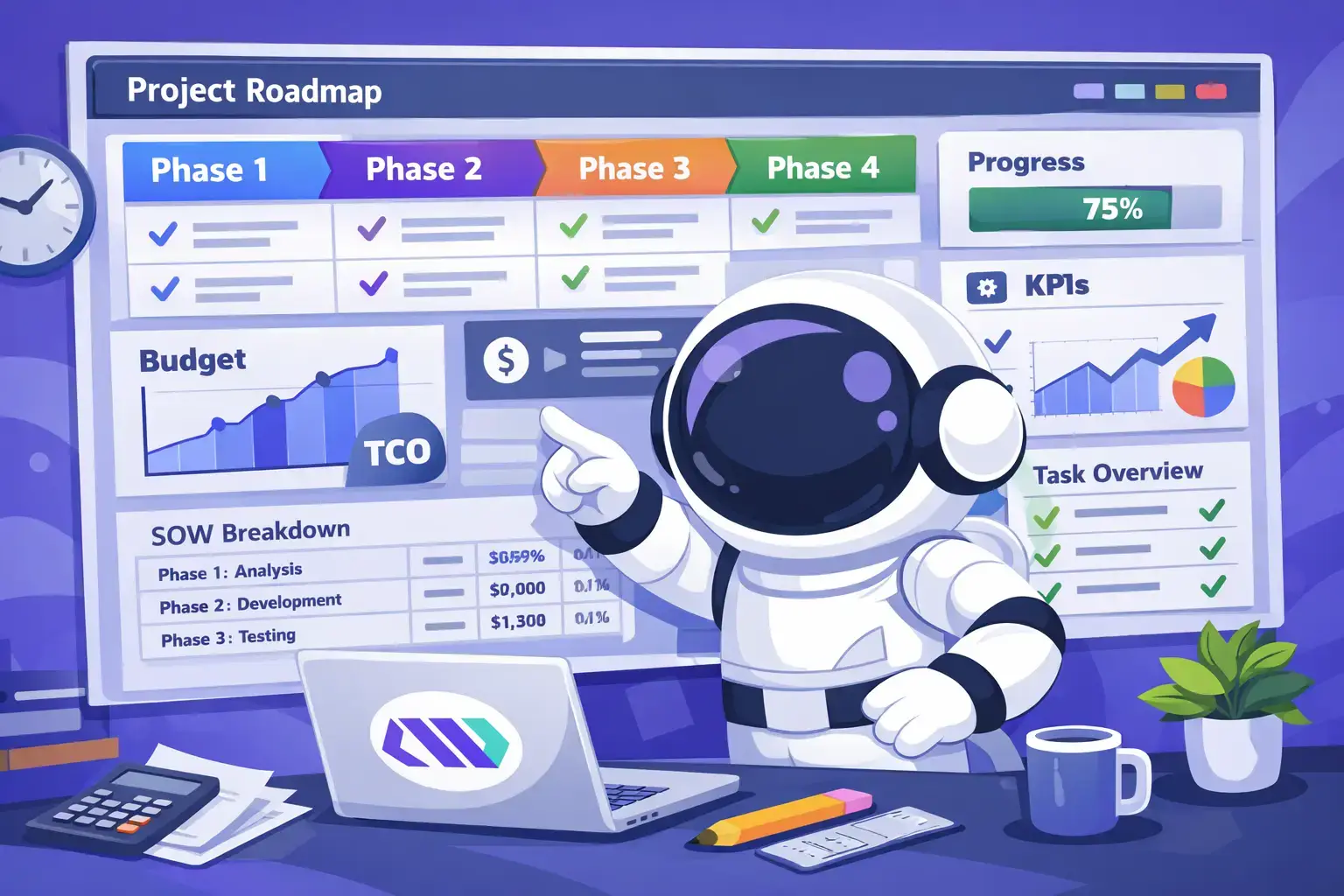
One of the primary drivers of unmanageable software expenses is the open-ended "time and materials" contract, which effectively rewards vendors for slow delivery. To maximize ROI, B2B organizations need financial predictability. The Codyweb Playbook enforces this through highly rigorous Statement of Work (SOW) documents that leave no room for functional ambiguity. We segment complex builds into well-defined, fixed-price phases. This structure places the burden of efficiency on the engineering team, not the client’s budget, and provides a clear mathematical ceiling for capital allocation at every milestone.
Transparency extends into our resource management through real-time project dashboards. These interfaces allow founders and technical leads to monitor task completion, ticket status, and development hours at any given moment. When you can see exactly where engineering effort is being directed, you can identify scope creep before it consumes your budget. This level of oversight transforms the vendor-client dynamic from a leap of faith into a data-driven partnership. It eliminates the "hidden fees" associated with maintenance by ensuring the initial code is written cleanly and documented thoroughly from day one.
A realistic use case involves a scaling SaaS startup that needs to integrate a complex third-party API for its users. In an opaque environment, the integration might balloon in complexity as engineers "explore" the solution. With a transparent dashboard and fixed-phase pricing, the startup knows exactly what the integration will cost and can track the progress daily. This discipline reduces the Total Cost of Ownership by preventing the waste of expensive developer hours on non-essential features, allowing the startup to preserve its runway for aggressive marketing and lead generation.
Accelerating Time-to-Market With Iterative Agile Visibility
In the aggressive US B2B market, being first to solve a specific pain point is often more valuable than having a perfect product. A delayed launch doesn't just cost development dollars; it costs market share. To optimize time-to-market, we utilize an agile development methodology that integrates the client directly into the engineering loop. By participating in weekly sprint reviews, your stakeholders see functional code as it is built, rather than waiting for a distant completion date. This iterative visibility removes the "approval lag" that routinely kills momentum in large-scale tech projects.
The technical engine of this speed is our continuous integration and continuous deployment (CI/CD) pipeline. This automated framework allows us to push functional updates to a staging environment multiple times a week. For a CMO, this means being able to show a functional prototype to key prospects or investors months ahead of the official launch. This early visibility is a powerful tool for lead generation, as it allows your sales team to gather real-world feedback and secure early-adopter commitments while the final product is still being refined. It shifts the product launch from a single, high-risk event to a series of low-risk, value-adding deployments.
Imagine a healthcare technology company developing a new provider dashboard. Using our transparent agile process, they can see the core UI within the first three weeks. If they realize a specific data visualization is critical for their pitch to a hospital network, we can reprioritize the backlog in real-time. This agility ensures the product evolves in alignment with current market demands, not an obsolete requirement list written months prior. The result is a high-velocity development cycle that captures revenue opportunities faster than competitors stuck in traditional, slow-moving silos.
Aligning Software Architecture With Aggressive Growth Goals
Software is not a static utility; it is a primary driver of your lead generation and customer acquisition strategy. A platform built without a deep understanding of your product-market fit will eventually require expensive re-engineering to support actual user growth. Our playbook mandates deep collaboration between our architects and your marketing and sales leadership from the initial discovery phase. We ensure that the technical roadmap is built to support specific commercial objectives, such as reducing the friction in your signup funnel or automating the delivery of high-value lead magnets.
Transparency in architectural design is particularly vital when it comes to scalability. We provide clear documentation on how your application handles concurrent user loads and data spikes. For a founder, knowing that the infrastructure can handle a 10x surge in traffic after a major national marketing campaign provides the confidence needed to invest heavily in acquisition. We also implement transparent security protocols that act as a competitive differentiator. When your sales team can present a prospective client with a detailed, auditable overview of the platform's data encryption and compliance measures, they close deals faster by removing security-related friction.
For example, a B2B logistics platform might find that their biggest barrier to closing enterprise deals is the complexity of their onboarding. By identifying this through our collaborative discovery process, we can engineer a custom automated onboarding workflow that reduces the manual effort for new clients. This technical solution directly lowers your customer acquisition cost (CAC) and speeds up the conversion of leads into active, paying accounts. By making the technical roadmap a visible part of the growth strategy, we ensure your software acts as a multiplier for your business performance.
Establishing Absolute Vendor Accountability Through Direct Access
The most common pain point in outsourced development is the "telephone game" where requirements are filtered through multiple layers of account managers, resulting in a final product that misses the strategic intent. We eliminate this by providing proactive communication and direct access to the engineers building your product. Your technical stakeholders can inspect code repositories, review automated test results, and communicate directly with lead developers via dedicated channels. This radical access ensures that the strategic vision is translated into code with absolute precision.
This level of transparency builds the trust necessary for a long-term technology partnership. You are not just a "client" receiving a finished box; you are a partner observing the engineering process. We provide detailed sprint reports that quantify progress and highlight potential risks before they impact the timeline. This vendor accountability ensures that your project stays on schedule and that the quality of the code meets enterprise standards. When problems arise—as they inevitably do in complex software—we communicate the solution immediately, preventing the expensive surprises that characterize traditional agency relationships.
Consider the impact on an internal IT team. Instead of managing a third-party vendor, they are collaborating with an extension of their own team. They can see the automated testing coverage and the deployment logs in real-time, ensuring that the new software will integrate seamlessly with existing legacy systems. This eliminates the "integration shock" that often occurs post-launch, further reducing the TCO and ensuring a smooth transition for your employees and customers alike. Direct access transforms software development from a risky procurement exercise into a predictable, manageable business process.
Securing Your Digital Future With a Transparent Tech Partner
Investing in custom software is a definitive commitment to the future of your enterprise. Continuing to operate within the "black box" model of development is a strategic risk that your organization cannot afford. To remain competitive in the 2026 digital economy, US businesses must demand a new standard of visibility, accountability, and strategic alignment from their technology partners. The Codyweb Playbook provides the structural framework to turn your digital initiatives into high-performance assets that drive sustained revenue and operational excellence.
By prioritizing transparency, you secure more than just a functional application; you secure the agility to pivot as your market evolves. You protect your profit margins by eradicating hidden costs and technical debt. You empower your marketing and sales teams with tools engineered to accelerate your lead generation and lower your CAC. Ultimately, you transform your technology stack from a source of frustration into a predictable engine for corporate growth. The clarity we provide in the development process leads directly to certainty in your business outcomes.
If your current software initiatives are plagued by budget uncertainty, delayed launches, or a lack of strategic alignment, it is time to audit your development process. Partner with an engineering firm that views transparency as a mandatory business requirement, not a luxury. Let us show you how a clear, visible, and accountable development journey can protect your ROI and position your enterprise for long-term dominance in your industry. Contact our team today to begin building the future of your business with absolute confidence.
- vote(s)