
Why Most Agency Selection Processes Fail (and How to Avoid the Common Traps)
When companies set out to hire a web development agency, they tend to default to the same broken playbook: collect three proposals, pick the one with the nicest slides, and hope for the best — yet understanding how to hire a web development agency properly requires a far more structured approach. The result is predictably poor. Agencies are selected on presentation skill rather than delivery track record, and the real project scope is never clearly defined before conversations begin.
The core failure is a misalignment of expectations. Buyers assume an agency will ask the right clarifying questions; agencies assume the buyer knows exactly what they want. Both assumptions are wrong. Without a defined scope, any price quoted is essentially fictional — a placeholder that will expand through change orders the moment reality intrudes.
A second trap — and one of the most common red flags in any search — is over-relying on name recognition or portfolio aesthetics. A visually impressive website produced three years ago tells you almost nothing about an agency's current technical capabilities, its project management discipline, or how it handles setbacks. The brands displayed in a portfolio section are marketing assets, not performance evidence.
Finally, buyers rarely involve the right internal stakeholders early enough. IT directors, marketing leads, and procurement teams often receive the shortlist only after a preferred vendor has already been emotionally selected. Getting all decision-makers aligned on how to hire a web development agency — and on shared agency selection criteria — before outreach begins is the single most effective way to avoid a politically messy reversal later.
Define Your Project Before You Talk to Anyone: Scope, Budget, and Timeline
The best thing you can do before reaching out to a single agency is to spend a week documenting your project internally. Not a vague brief — a working specification that covers what the deliverable is, what problem it solves, who will use it, and what success looks like in measurable terms. Agencies that receive this document respond with far more accurate proposals, and the ones who cannot engage seriously with a written brief are immediately disqualified.

Budget transparency is equally critical. Many B2B buyers withhold their budget expecting to negotiate down from whatever the agency proposes. This strategy routinely backfires: agencies either overprice to create negotiation room or underprice to win, then recover margin through scope creep. Sharing a realistic budget range early filters out mismatched partners and enables honest conversations about trade-offs.
Timeline definition must be grounded in reality, not wishful thinking. If your product needs to be live before a major industry event, say so explicitly — and ask agencies how they would structure the project to meet that constraint. A credible agency will immediately begin discussing phasing, MVP scope reduction, or resource allocation. An agency that simply says "yes, no problem" without interrogating the constraint is giving you a sales answer, not a delivery answer.
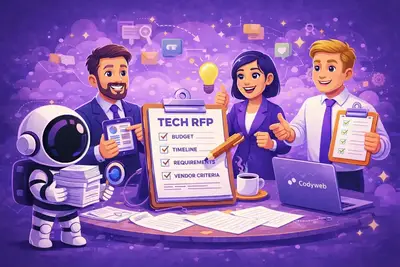
At this stage, it is also worth clarifying technology preferences or constraints. If your internal IT team must maintain the platform post-launch, the stack matters. If you operate within a regulated industry, compliance requirements shape the architecture. These inputs belong in your brief, not in a follow-up email six weeks into the engagement. You can explore the complete guide to drafting a technical RFP for agency hiring to structure this document properly.
8 Non-Negotiable Questions to Ask Any Web Development Agency
When you know how to hire a web development agency properly, the questions you ask during initial conversations reveal far more than any portfolio walk-through. Below are eight questions that cut through the sales pitch and surface how an agency actually operates.
- Who will be working on my project day-to-day? — Identify the actual team, not the senior partners who appear in the pitch.
- How do you handle scope changes? — Listen for a documented change order process, not a vague "we're flexible."
- Can you share a post-mortem from a project that ran into trouble? — Agencies that have never faced a problem either haven't done enough projects or won't be honest with you.
- What is your testing and QA process before delivery? — Automated testing, browser compatibility checks, and performance benchmarks should be standard, not optional.
- How do you ensure SEO fundamentals are built in, not bolted on? — Technical SEO considerations — crawlability, Core Web Vitals, structured data — should be part of the development workflow.
- What does the handover process look like? — Documentation, training, and access management at project close are often neglected and very costly to retrofit.
- How do you measure project success? — An agency that defines success only as "delivery on time" is not thinking about your business outcomes.
- Do you have experience with sustainability requirements? — In 2026, environmental performance is a procurement criterion in many sectors; an eco-friendly approach to web development is no longer a nice-to-have for ESG-conscious organizations.
Record and compare answers across agencies. Patterns will emerge quickly: some teams are process-driven and transparent; others improvise and over-promise. You want the former.
How to Evaluate Portfolios, Case Studies, and Technical Fit
Knowing how to hire a web development agency means looking past the surface of a portfolio. Every agency curates its best work; your job is to find out whether that work is representative or exceptional. Ask for case studies from projects similar to yours in project scope, industry, and technical complexity — not just the most visually striking examples.
A strong case study includes a defined problem, the approach taken, specific technical decisions and why they were made, and measurable outcomes. If an agency can only show you screenshots and a client logo, the case study is essentially a testimonial without substance. Push for quantified results: load time improvements, conversion rate changes, organic traffic growth, or reduction in infrastructure costs.
Technical fit assessment goes beyond the tech stack. It includes how the agency approaches architecture decisions — whether they recommend what is genuinely right for your use case or simply default to their preferred tools. An agency that proposes a headless architecture for a 12-page brochure site, or a monolithic CMS for a complex multi-tenant application, is not listening to your requirements. Reading about the trade-offs in monolithic vs. microservices architectures will help you ask sharper questions about these decisions.
Finally, assess cultural and communication fit. Will you receive weekly written updates or ad-hoc Slack messages? Is there a dedicated project manager, or will you be coordinating directly with developers? Mismatched communication styles cause more project failures than technical incompetence. Ask for a sample project status report during the proposal evaluation phase — it tells you everything about how an agency operates when things get complex.
Red Flags That Signal an Agency Will Deliver Late, Over Budget, or Both
Learning how to hire a web development agency includes learning what to walk away from. Certain behaviors during the sales process are reliable predictors of delivery problems. A proposal that arrives without any clarifying questions being asked first suggests the agency is submitting a template, not a tailored response. That template will not survive contact with your actual requirements.
Vague pricing is another serious warning sign. If a proposal lists "development" as a single line item without breakdown, you have no basis for evaluating value or tracking costs. Transparent agencies itemize work by phase, feature, or sprint — and they can justify each line. Opaque pricing almost always hides either inexperience or a plan to recover margin through change orders.
Be cautious when an agency cannot clearly explain its project management methodology. Whether they use agile sprints, a phased waterfall approach, or a hybrid model, the methodology should be documented and consistently applied — not invented per project. Agencies that describe their process as "we adapt to whatever the client needs" are often signaling an absence of internal discipline.
Watch for excessive reliance on third-party plugins, off-the-shelf templates, or undisclosed subcontracting. There is nothing inherently wrong with using established libraries or working with specialist partners — but these arrangements should be disclosed upfront, not discovered after the contract is signed. Hidden subcontracting in particular can introduce serious quality and accountability gaps. If managing technical debt is already a concern on your side, check how the agency addresses legacy refactoring and technical debt in their delivery process.
Ready to Move Forward? Here Is How to Find the Right Agency for Your Project
Once you have applied this checklist and identified one or two genuinely credible partners, the final step in understanding how to hire a web development agency is validating the onboarding process before you sign. A trustworthy agency will conduct a structured discovery phase — paid or as part of the proposal — during which they validate your brief, surface hidden requirements, and produce a refined specification. Agencies that want to jump straight to contracts and invoices without discovery are cutting the corner most likely to cause problems.
Review the contract carefully for clarity on intellectual property ownership, milestone-based payment terms, delivery acceptance criteria, and termination clauses. These are not bureaucratic formalities — they are the mechanisms that protect you if the relationship breaks down. Any agency that resists standard IP assignment clauses or milestone-based payments is exposing a risk you should price into your decision.
The onboarding weeks themselves are a test. Is the kickoff meeting structured with a clear agenda? Are roles and responsibilities confirmed in writing? Is there a shared project management workspace where you can track progress without chasing updates? A well-run first month predicts a well-run project. If the early communication is already disorganized, it will not improve under deadline pressure.
Codyweb works with B2B organizations that need custom web development delivered with full transparency, technical rigor, and measurable performance outcomes. Explore our web design and development services or review our approach to see whether it matches your project's requirements. Knowing how to hire a web development agency — from initial agency selection through to contract signing — is the first step — finding one that applies these standards consistently is the second.
- vote(s)