
The Strategic Imperative of Progressive Web Apps in 2026
By 2026, the digital environment has firmly established accessibility, speed, and cost-efficiency as the primary drivers of enterprise success. Progressive Web Apps (PWAs) have transitioned from an emerging technology to a mature, robust architectural standard that fundamentally upgrades how B2B organizations deploy their mobile presence. For Chief Technology Officers, founders, and marketing directors, transitioning to a PWA represents a calculated maneuver to secure a distinct competitive advantage. The traditional strategy of sinking massive capital into platform-specific native applications is rapidly becoming obsolete, replaced by an integrated methodology that fiercely protects Return on Investment (ROI) and systematically lowers Total Cost of Ownership (TCO). This evolution ensures your digital products perform exceptionally without the inherent friction of app store downloads.
Modern B2B buyers operate with high expectations and limited patience. Forcing a prospective enterprise client or a busy vendor to navigate a proprietary app store, download a heavy file, and manage subsequent updates introduces severe barriers to entry. A PWA eliminates this friction entirely. It delivers a unified, highly responsive experience directly through any standard web browser while retaining the advanced functionalities typically reserved for installed software. Users gain immediate access to your customized business tools, client portals, or internal dashboards via a simple URL, creating an instant connection that traditional mobile applications struggle to match.
Our engineering teams focus on building custom PWAs that align precisely with your proprietary business logic. Rather than adapting your operations to fit the rigid constraints of a generic SaaS mobile template, we architect Progressive Web Apps from the ground up to support your specific workflows. This bespoke approach solves complex operational challenges, ranging from secure B2B customer acquisition to efficient internal data management. By consolidating your digital footprint into a high-performance web application, your enterprise achieves unparalleled agility, ensuring you can adapt to market shifts instantly while maintaining strict budgetary control.
The Hidden Financial Drain of Native App Development
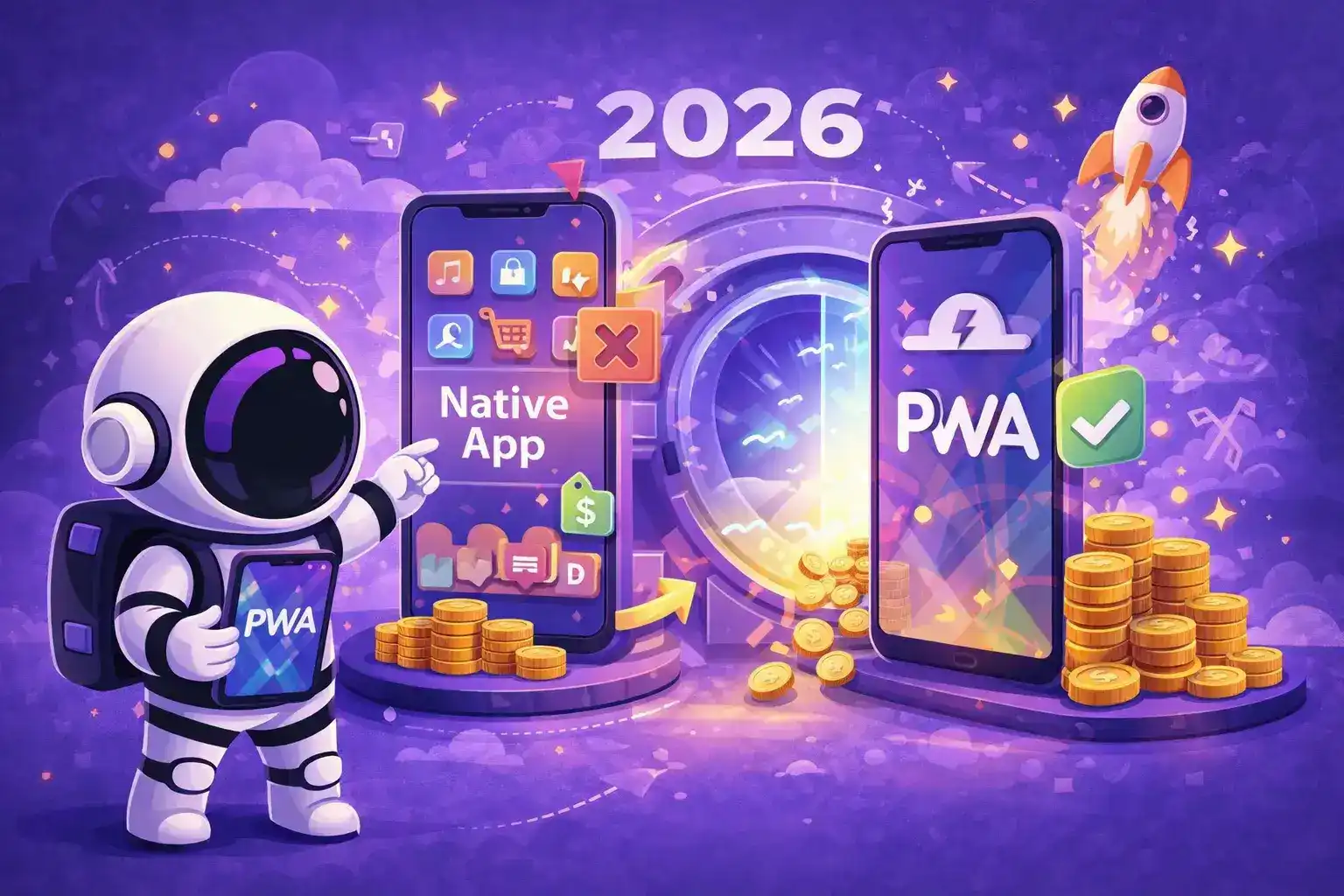
The historical appeal of dedicated native mobile applications often masked a severe financial and operational burden. Engineering a true native experience dictates the maintenance of entirely separate development teams for iOS and Android platforms. This fundamental requirement immediately doubles your initial capital expenditure. Your organization must fund two distinct codebases, manage two divergent project timelines, and troubleshoot two entirely different sets of software bugs. For scaling startups and established enterprises alike, this duplicated effort drains resources that should be allocated toward market expansion and core product innovation.
Beyond the expensive initial build phase, the ongoing maintenance overhead creates a permanent drag on your profit margins. Every time Apple or Google releases an operating system update, introduces a new device iteration, or modifies their strict compliance guidelines, your engineering department must halt feature development to execute parallel updates. This continuous cycle of mandatory debugging, performance optimization, and forced redeployment across disparate platforms consumes thousands of developer hours annually. It transforms your IT department from a proactive growth engine into a reactive maintenance crew, severely inflating your long-term TCO.
Furthermore, the proprietary nature of app stores introduces external control over your business operations. Mandatory review processes frequently delay the time-to-market for critical security patches or highly anticipated feature releases. Managing these fragmented listings, navigating arbitrary rejections, and attempting to synchronize marketing campaigns across a website, an iOS app, and an Android app creates administrative chaos. The resulting data silos obscure your analytics, making it exceedingly difficult for CMOs to track user journeys accurately and optimize their acquisition funnels. Transitioning away from this fragmented model is a financial necessity for sustainable enterprise growth.
Maximizing ROI Through a Unified Codebase Architecture
The financial argument for adopting Progressive Web Apps directly targets the structural inefficiencies of native development. The primary mechanical advantage of a PWA is its reliance on a single, unified codebase. By leveraging standard, highly supported web technologies like HTML, CSS, and modern JavaScript frameworks, a single engineering team produces an application that functions flawlessly across desktop monitors, tablets, and smartphones. This architectural consolidation immediately slashes your initial development costs and permanently reduces the headcount required for ongoing technical support.
Because the application lives on the web, your maintenance costs drop dramatically. When your team develops a new feature, patches a vulnerability, or refines the user interface, they deploy the code once to your central web server. This update becomes instantly active for every single user globally the next time they access the application. You completely bypass the tedious app store submission protocols and the unpredictable approval delays imposed by platform gatekeepers. This streamlined deployment pipeline guarantees that your clients and employees are always utilizing the most secure, feature-rich version of your software without requiring any manual intervention on their devices.
Additionally, escaping the app store ecosystem directly improves your bottom line by eliminating distribution fees and mandatory revenue sharing on digital transactions. Your enterprise retains total control over its billing infrastructure and payment gateways. From a server-side perspective, serving a highly optimized PWA often demands less complex infrastructure than supporting the backend API requirements of multiple disconnected native apps. By consolidating development efforts, accelerating deployment cycles, and removing third-party financial interference, PWAs deliver a superior financial profile that frees up substantial capital for aggressive corporate expansion.
Accelerating Time-to-Market and Operational Agility
In highly competitive B2B sectors, operational velocity dictates market leadership. The capacity to conceptualize, build, and launch new digital capabilities rapidly provides a distinct advantage over slower competitors clinging to legacy systems. Progressive Web Apps offer an unparalleled acceleration in your time-to-market. Because developers are not forced to write, compile, and test code for different operating systems sequentially, the entire development timeline is heavily compressed. New enterprise tools and client-facing features move from the staging environment to production in a fraction of the time traditionally required.
This organizational agility extends significantly beyond the initial product launch. B2B software requires continuous refinement based on active user feedback and shifting industry regulations. With a PWA, market feedback is integrated rapidly. If a key enterprise client requests a specific modification to a reporting dashboard, your team can push that update live immediately. You operate entirely outside the jurisdiction of app store review boards, allowing your business to pivot swiftly, counter competitor moves, and deploy critical hotfixes within hours rather than weeks.
This iterative, continuous delivery model fundamentally alters how product managers operate. It enables a pragmatic "test and learn" methodology where beta features are deployed to a segmented user base, analyzed using real-world engagement data, and refined before a global rollout. This capability severely reduces the financial risk associated with massive, monolithic product updates. By ensuring your engineering pipeline remains fluid and highly responsive, a PWA guarantees that your digital offerings consistently align with the immediate demands of your target market, securing your position as an agile industry leader.
Engineering Superior User Experiences for Lead Generation
For marketing directors and sales executives, a digital platform's ultimate purpose is to capture attention, build trust, and drive high-value conversions. Progressive Web Apps are specifically engineered to deliver an exceptional, low-friction user experience that directly accelerates lead generation and fortifies client retention. Unlike native applications hidden behind the walled gardens of app stores, PWAs are fully indexable by Google. This provides a massive Search Engine Optimization (SEO) advantage, allowing your proprietary tools and gated content to rank organically, capturing high-intent B2B traffic directly from search engine result pages.
Once a prospect lands on the application, the PWA utilizes advanced browser capabilities to mimic native functionality. Service Workers enable robust offline capabilities, allowing users to load previously accessed data, review documents, or fill out forms even when experiencing unstable internet connections. This reliability prevents frustration and ensures critical business tasks are not interrupted by poor connectivity. Furthermore, the implementation of secure push notifications allows marketing teams to re-engage dormant users with highly targeted updates, contract renewal reminders, or new feature announcements, directly pulling them back into the conversion funnel.
The strategic "Add to Home Screen" functionality represents a major victory for user adoption. With a single tap, a prospective client saves your customized PWA icon directly to their mobile device, making it visually indistinguishable from a downloaded app. This bypasses the heavy psychological friction of committing to an app store installation. Combined with near-instant loading speeds achieved through intelligent asset caching, the application virtually eliminates bounce rates. A faster, highly reliable interface naturally fosters deeper engagement, prolongs session durations, and significantly increases the probability of a user completing a high-value action, such as requesting a customized software demo or submitting a detailed RFQ.
Navigating the Enterprise Transition to PWA Architecture
For executive decision-makers acknowledging the undeniable benefits of Progressive Web Apps, execution requires a pragmatic, carefully phased strategy. Migrating your digital infrastructure is not merely a codebase translation; it represents a comprehensive realignment of your IT resource allocation and digital acquisition strategies. The initial phase involves a rigorous audit of your existing mobile footprint. Leadership must objectively calculate the true TCO of maintaining current native applications, factoring in developer salaries, delayed launch costs, and lost conversions due to installation friction. This financial baseline provides the concrete justification required for architectural modernization.
Transitioning to a PWA does not strictly mandate the immediate destruction of existing native assets. A highly effective mitigation strategy involves a phased rollout. Enterprises frequently deploy a custom PWA to serve as their primary, high-traffic mobile portal for new customer acquisition and lead generation, while maintaining legacy native apps strictly for highly specific internal hardware integrations if absolutely necessary. You begin by transforming your core web presence into a high-performance PWA, instantly capitalizing on the SEO benefits and the frictionless mobile experience without interrupting existing deeply integrated workflows.
Executing this transition successfully requires partnering with a technical team that understands B2B complexities. You need engineers who prioritize robust security architectures, API integrations with your existing CRM or ERP systems, and absolute data compliance. By strategically adopting custom PWA technology, your organization future-proofs its mobile strategy against the volatile policies of third-party app stores. You unlock massive operational cost savings while delivering a vastly superior, highly accessible digital product to your clients, cementing your technological authority in the 2026 market.
- vote(s)