
Key takeaways
- Opacity in development lets misaligned requirements go unnoticed for months, which inflates the total cost of ownership.
- Fixed-price phases defined in a detailed statement of work give leadership a clear budget at every milestone.
- Weekly sprint reviews and direct access to engineers turn the vendor relationship into a verifiable partnership.
The hidden financial toll of opaque development cycles
For US decision-makers such as CTOs, CMOs and founders, approving a custom software build often feels like handing a blank check to a black box. Traditional development models rarely provide the visibility needed to follow how budget turns into working features. This opacity is not only a communication issue, because it directly inflates the total cost of ownership (TCO). When leadership cannot see the incremental progress of a build, small misalignments in business requirements remain undetected for months, and by the time they surface, correcting them costs far more than it would have at the start.
The frustration of B2B executives often stems from a lack of accountability in the engineering process. Without regular insight into resource allocation and sprint progress, technical debt accumulates unnoticed and eventually degrades the application's performance. The Codyweb playbook addresses this by treating transparent B2B software development as a financial and strategic discipline. We share the information leadership needs to make informed decisions, so that the budget builds a competitive advantage rather than financing inefficient workflows or redundant code.
Consider a mid-market financial services firm launching a proprietary client portal. Under a traditional sequential model, the firm might wait months for a final reveal, only to discover that the security protocols do not meet its compliance requirements, and the resulting rework can delay the launch considerably. A transparent framework exposes these architectural decisions as they are made and allows immediate course correction, so that the product arrives ready to generate revenue.
The playbook rests on five commitments, each of which is detailed in the sections below.
- Scoping before code. Every collaboration starts with an immersion phase in which we analyze your needs, constraints and objectives with your team.
- Fixed-price phases. Complex builds are divided into well-defined phases described in a statement of work, which gives a clear budget at each milestone.
- Visible progress. Project dashboards show task completion and ticket status, so you can follow where engineering effort goes.
- Weekly sprint reviews. Your stakeholders see working code as it is built rather than waiting for a distant delivery date.
- Direct access to engineers. You work with the people who design and build your product, without layers of intermediaries.
None of these commitments is complex on its own. Their value comes from applying all five consistently, from the first workshop to the final release.
Lowering TCO through fixed-phase pricing and detailed SOWs
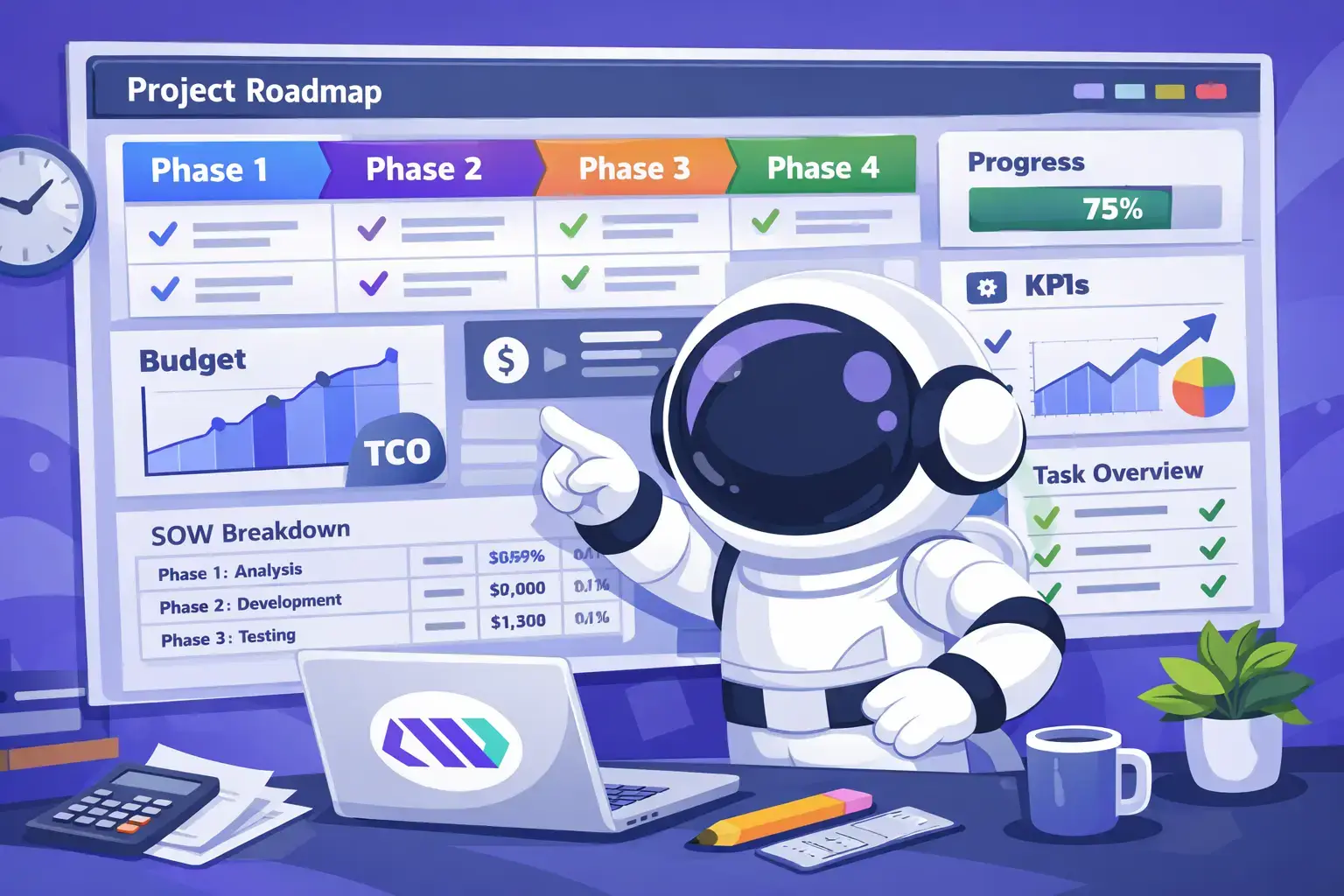
One of the main drivers of runaway software costs is the open-ended time-and-materials contract, which gives the vendor little incentive to deliver efficiently. To protect their return on investment (ROI), B2B organizations need financial predictability. The playbook provides it through a statement of work (SOW) precise enough to leave no room for functional ambiguity, and through the segmentation of complex builds into well-defined, fixed-price phases. This structure places the burden of efficiency on the engineering team rather than on the client's budget.
Transparency extends to resource management through project dashboards. Founders and technical leads can follow task completion, ticket status and development effort at any time, which makes scope creep visible before it consumes the budget. This oversight changes the vendor relationship from a leap of faith into a partnership based on shared information. It also reduces future maintenance costs, because code that is written cleanly and documented from the first day is cheaper to evolve.
Take a growing SaaS company that needs to integrate a complex third-party API for its users. In an opaque setting, the integration can expand in complexity while engineers explore possible solutions. With a visible dashboard and fixed-phase pricing, the company knows what the integration will cost and can follow its progress, which protects its runway for marketing and lead generation. Defining these phases starts before the first contact with any vendor, and our guide on writing a tech RFP that agencies can price accurately explains how to prepare them.
Accelerating time-to-market with iterative agile visibility
In the US B2B market, being first to solve a specific pain point is often worth more than launching a perfect product later. A delayed launch costs development budget, and it also costs market share. To shorten time-to-market, the playbook relies on an agile development methodology that integrates the client directly into the engineering loop. By taking part in weekly sprint reviews, your stakeholders see working code as it is built, which removes the approval delays that so often stall large technology projects.
The technical engine behind this pace is a continuous integration and continuous deployment (CI/CD) pipeline. This automated process pushes working updates to a staging environment frequently, so a CMO can show a functional prototype to key prospects or investors well before the official launch. Early visibility also supports sales, since the team gathers real-world feedback while the product is still being refined. The launch becomes a series of low-risk deployments rather than a single high-risk event.
Imagine a healthcare technology company developing a new dashboard for care providers. With an iterative process, the core interface is visible early in the project. If the company realizes that a specific data visualization is decisive for a pitch to a hospital network, the backlog can be reprioritized immediately, and the product evolves with market demand instead of following a requirement list written months earlier. The same discipline underpins our method for large builds, as described in how we deliver complex web applications on time and on budget.
Aligning software architecture with growth goals
Software is not a static utility, since it supports customer acquisition and lead generation. A platform built without a clear understanding of your product-market fit will eventually require expensive re-engineering to support real user growth. The playbook therefore involves our architects alongside your marketing and sales leadership from the discovery phase, so that the technical roadmap serves specific commercial objectives, such as reducing friction in a signup funnel or automating the delivery of high-value content.
Transparency in architectural design matters most when it comes to scalability. We document how the application handles concurrent users and data spikes, which gives a founder the confidence to invest in a national marketing campaign without fearing that the infrastructure will give way. Security protocols are documented in the same way, and when your sales team can present an auditable overview of data encryption and compliance measures to a prospective client, security questions stop slowing down the deal. Architecture choices made early also determine how much technical debt the application will accumulate over the years.
A B2B logistics platform, for example, might find that its biggest obstacle to closing enterprise deals is the complexity of client onboarding. Once the collaborative discovery process identifies this, an automated onboarding workflow can reduce the manual effort required for each new account, which lowers the customer acquisition cost (CAC) and speeds up the conversion of leads into paying clients.
Establishing vendor accountability through direct access
The most common pain point in outsourced development is the chain of intermediaries through which requirements are filtered, until the final product misses the strategic intent. The playbook avoids this through proactive communication and direct access to the engineers building your product. Your technical stakeholders can inspect code repositories, review automated test results and talk directly with lead developers through dedicated channels, so the strategic vision is translated into code without distortion.
This level of transparency builds the trust required for a long-term technology partnership. You do not simply receive a finished product: you follow the engineering process as it unfolds. Detailed sprint reports quantify progress and highlight risks before they affect the timeline. When problems arise, as they always do in complex software, we explain the issue and the proposed solution immediately, which prevents the expensive surprises that characterize so many agency relationships.
The impact on an internal IT team is significant. Instead of managing a distant vendor, it collaborates with an extension of its own team, follows test coverage and deployment logs, and checks that the new software will integrate properly with existing systems. This reduces the integration problems that often appear after launch and keeps the TCO under control. Direct access turns software development from a risky procurement exercise into a manageable business process, which is the spirit of our direct and transparent approach.
Securing your digital future with a transparent tech partner
Investing in custom software is a long-term commitment for any company, and continuing to work within a black-box development model is a strategic risk. To remain competitive, US businesses can expect more visibility, accountability and strategic alignment from their technology partners. The Codyweb playbook provides a framework for turning digital initiatives into assets that support revenue and operational performance.
By prioritizing transparency, you secure more than a functional application. You keep the ability to adjust the product as your market evolves, you protect your margins by limiting hidden costs and technical debt, and you give your marketing and sales teams tools designed to support lead generation. The clarity of the development process translates into clearer business decisions.
If your current software projects suffer from budget uncertainty, delayed launches or a lack of strategic alignment, the first step is to compare your current vendor with the criteria in our guide on how to evaluate a web development agency. The second is to discuss your project with a team that treats transparency as a working requirement.
- vote(s)