
Key takeaways
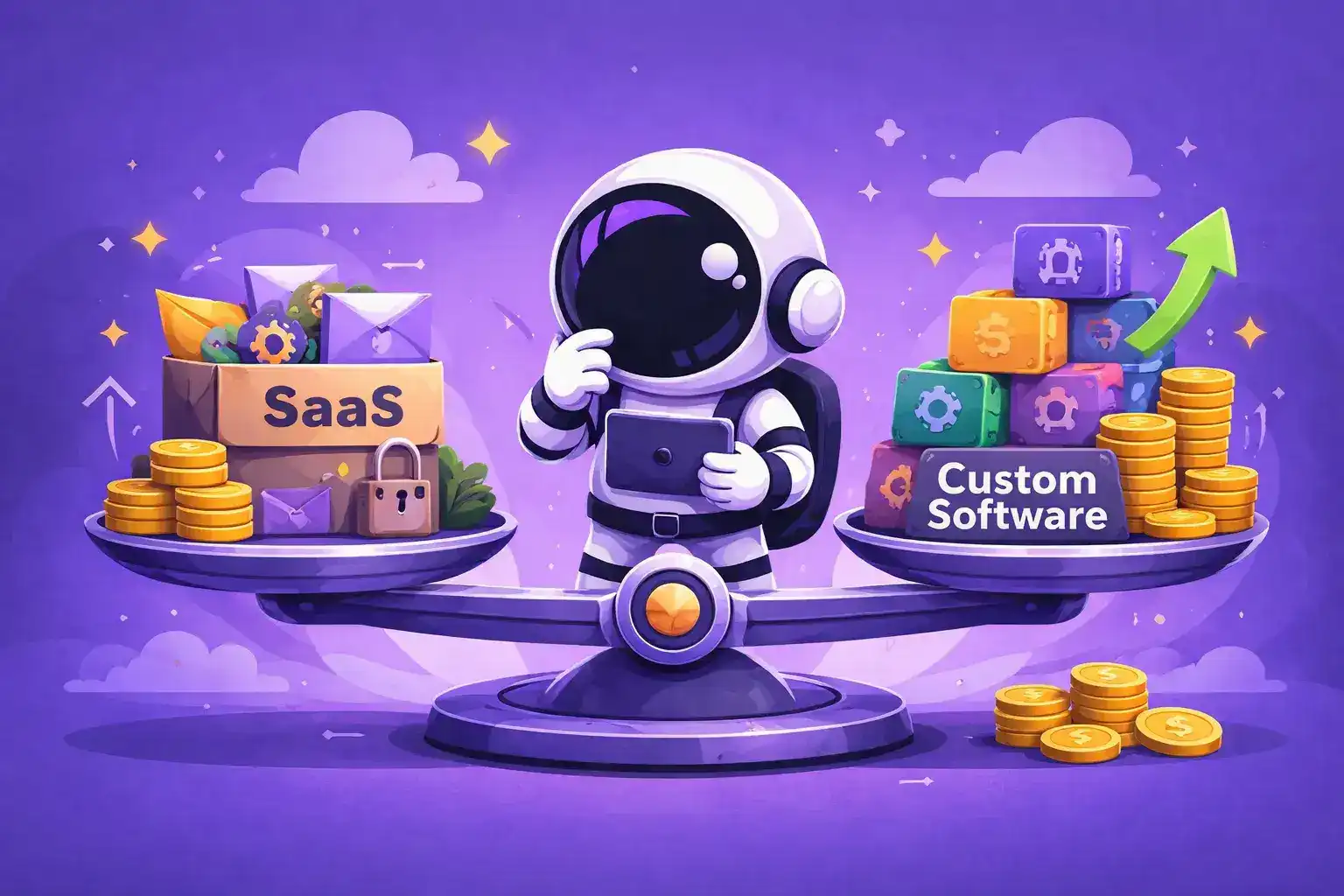
- Off-the-shelf SaaS is quick to start, but per-seat pricing and premium tiers make its cost grow with your company.
- Custom software is a higher upfront investment in an asset you own, with no license fees as you add users.
- The right choice comes from a multi-year ROI calculation that includes integrations, workarounds and time saved.
The hidden financial drain of off-the-shelf SaaS platforms
For US decision-makers, the initial appeal of off-the-shelf Software as a Service (SaaS) is easy to understand. Vendors promise immediate deployment, predictable monthly billing and standardized features that cover basic operational needs. As an organization grows, however, this convenience can turn into a financial and operational constraint. Generic platforms impose predefined workflows, and when your processes must bend to the limits of the software, productivity suffers: teams invent manual workarounds, manage data across disconnected spreadsheets and lose hours to systems that were never designed for their industry.
The most underestimated aspect of the model is the growth of the total cost of ownership (TCO). Subscription pricing scales with your activity: as you hire employees, process more transactions or need advanced integrations, vendors move you to higher pricing tiers. A tool that was inexpensive during the startup phase can become one of the largest lines in the software budget once the company reaches enterprise scale. Connecting several SaaS tools also requires third-party middleware and continuous API maintenance, which adds fragile failure points to core operations.
Many mid-market companies also pay per-seat licenses for large feature sets of which their staff uses only a fraction. Mapping your actual workflows against the features you pay for shows how much of the software budget finances functions nobody uses, and recognizing this inefficiency is the first step toward reclaiming it.
Consider a growing B2B logistics firm that relies on three separate SaaS platforms for inventory routing, client communication and invoicing. Because the systems do not communicate natively, account managers spend part of each week copying tracking numbers from one database to another, with the errors that this inevitably produces. The friction weighs on margins and limits the firm's ability to take on larger contracts. Escaping this trap requires a change of perspective, from renting generic tools to owning a proprietary digital asset.
Building custom software for strategic ROI
The alternative to generic subscriptions is the development of a custom software solution. Decision-makers rightly note that bespoke development requires a higher initial investment, but they often underestimate the returns it generates over time. Custom software is a proprietary asset that the company owns outright: every function is designed to support your exact processes, there are no redundant features and no per-user license fees that penalize growth.
Our approach starts from your commercial objectives rather than from a software template. We begin with an immersion phase to understand how your business generates revenue, then build a secure, scalable architecture that reflects your optimized workflows. Whether you need an internal tool to streamline production or a custom client portal, intranet or extranet to automate onboarding, the application executes your business rules as they are, not as a vendor imagined them.
Take the example of a staffing agency facing complex, state-by-state credential verification rules that generic HR software cannot handle. A custom credentialing module can check each file against the applicable rules, flag expired licenses automatically and remove a large share of manual verification. The time saved goes directly to payroll savings and lowers the baseline operating cost.
When you own your technology stack, financial forecasting also becomes more reliable. Price increases decided by a vendor no longer affect you, and infrastructure costs evolve with actual server usage and data storage rather than with user seat thresholds. CFOs and founders can then plan expansion knowing that the core technology is an asset, not a variable liability.
How to compare the ROI of SaaS and custom software
A reliable comparison does not oppose a monthly subscription to a one-off development quote. It compares the full cost of each option over the same period, usually several years, and the value each one creates. The five steps below structure this calculation.
- Project the subscription cost. Multiply the current per-seat price by the headcount you expect in each of the coming years, and include the higher tiers you will need for advanced features.
- Add integration and workaround costs. Count the middleware, connectors and hours spent re-entering data between tools, which rarely appear in the vendor's quote.
- Estimate the custom option in full. Include development, hosting, maintenance and the evolutions you already foresee, not only the initial build.
- Value the gains. Translate time saved, errors avoided and faster client response into money, using your own payroll and margin figures.
- Compare the payback period. The option that recovers its cost first, and keeps lower recurring costs afterwards, is the stronger investment.
The table below summarizes how the two options usually behave on the main criteria.
| Criterion | Off-the-shelf SaaS | Custom software |
|---|---|---|
| Upfront cost | Low | Higher, spread over the project phases |
| Recurring cost | Grows with users and tiers | Hosting and maintenance, independent of seats |
| Fit with processes | Processes adapt to the tool | The tool follows your processes |
| Ownership | Rented access | Source code owned by the company |
| Roadmap | Decided by the vendor | Decided by you |
SaaS remains the sensible choice for commodity functions such as email, accounting or video conferencing, where your processes resemble everyone else's. Custom development pays off where your workflows are specific, where several tools must share data, or where the software itself differentiates you from competitors. The same reasoning applies to websites, as explained in our article on custom native code versus a CMS for enterprise clients.
Accelerating time-to-market without sacrificing precision
A common fear about custom builds is the length of development. Vendors readily suggest that custom software takes years, which pushes companies toward immediate compromises. Yet enterprise SaaS implementation is rarely instant either: adapting a rigid platform to a complex B2B workflow often requires months of consulting, configuration and user training, and in some cases this takes longer than building the right tool from scratch.
Modern agile methods reduce this risk. Instead of a multi-year waterfall plan, the project starts with a minimum viable product (MVP) focused on the highest-priority business functions, those that directly drive lead generation or operating savings. For an intranet or an extranet, for example, development generally takes between six and twelve weeks after the analysis phase, depending on scope and complexity. The business starts benefiting from the software early, and the following phases build on real usage.
Once the MVP is in production, continuous integration and deployment pipelines allow regular updates, so the software evolves with user feedback rather than internal assumptions. When an unexpected opportunity appears, you can prioritize the corresponding feature in your own roadmap instead of waiting for a SaaS vendor to consider your request. Because the new feature shares the same data as the rest of your tools, it strengthens the whole platform, which is the logic of an integrated tech ecosystem that protects your ROI.
Imagine a financial services company that must launch a specialized underwriting tool to secure a strategic partnership. If SaaS providers propose a long customization project with no assurance of success, a custom MVP limited to the underwriting workflow can be the faster route to the deadline, while leaving room to extend the tool once the partnership is signed.
Data ownership and compliance as a competitive asset
Corporate data is among your most valuable intellectual property. Entrusting client lists, financial records and operational metrics to a third-party SaaS vendor carries strategic risks. In a shared multi-tenant environment, the security of your data depends on the vendor's practices, and a breach on its side exposes your information. Extracting your data to change providers can also be difficult, which creates a form of vendor lock-in.
Custom software gives you control over your data. You own the database and the source code, and you decide where the data is hosted, who can access it and how it is backed up. Encryption, secure access protocols and regular backups are part of the platform from the start, so your intellectual property remains an exclusive corporate asset.
For organizations in regulated sectors, this control matters even more. Companies handling health data must apply the safeguards required by HIPAA, those processing personal information of California residents must respect the rights granted by the CCPA, and enterprise buyers often ask their suppliers for a SOC 2 report issued by an independent CPA firm. With generic tools, compliance-ready tiers are usually sold at a premium, and your IT team has limited visibility into the vendor's actual security practices. A custom application can include audit logs, role-based access controls and automated data retention policies from the first version, which makes security questionnaires from large clients easier to answer.
Turning proprietary tech into a lead generation engine
If your company uses exactly the same SaaS tools as its competitors, it struggles to offer a differentiated customer experience. In crowded markets, B2B buyers judge suppliers by how easy they are to work with, and a generic client portal identical to everyone else's pushes your sales team to compete on price alone. Custom software changes this by turning your digital interfaces into tools for acquisition and retention.
Custom development lets you design a user experience that supports your own sales process and offer features your competitors cannot: a visual product configurator, an automated pricing calculator or a client dashboard with real-time operational data. When prospects use a polished, highly functional platform during a demo, they perceive your company as a more capable partner.
Consider a building materials supplier whose sales team loses deals because generic quoting software takes days to produce a complex proposal. A custom quoting engine connected through APIs to live supplier databases would let sales representatives generate accurate, branded proposals on a tablet while still on the construction site. Responsiveness of this kind is hard for competitors to match, and it is designed on the principles of an API-first architecture.
Securing long-term control over your technology
The choice between renting generic software and building custom solutions reflects the role you give technology in your strategy. Companies that treat software only as an operating expense keep absorbing the growing costs, security dependencies and functional limits of off-the-shelf tools, and adapt their business to the constraints of external vendors. Those that see technology as a driver of company value choose to build and own the tools that make them different.
Investing in custom software means that your technology grows with your revenue, that your data remains under your control and that you can respond quickly to changes in your industry. By removing recurring license fees and manual inefficiencies, a bespoke platform lowers baseline operating costs over the long term. Before scaling, it is also worth checking how the architecture will behave as usage grows, since poorly structured cloud applications become expensive to scale.
The decision deserves a precise calculation rather than a principle. Start by listing the subscriptions, integrations and workarounds your teams rely on today, then compare them with the cost of a tool designed for your processes and owned by your company.
- vote(s)