
Key takeaways
- With AI Overviews answering many queries directly, only content with original, first-hand expertise still earns the click.
- Slow, plugin-heavy sites lose prospects before the first scroll, whereas a lightweight custom build lowers the cost of every lead.
- Leads come from buying-intent pages and short forms, not from traffic volume alone.
The high cost of digital invisibility in the AI era
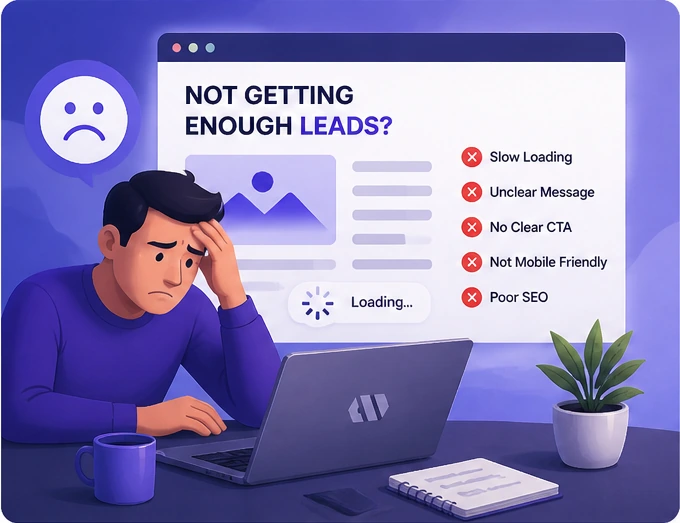
In a competitive American market, a website that merely acts as a digital placeholder has become a liability. Google started rolling out AI Overviews to all users in the United States in May 2024, and these generated summaries now answer many questions before anyone clicks a result. Many small business owners therefore see their website attract visitors while the number of qualified requests stagnates. When a small business website is not getting leads, the cause is rarely a single bug: it is usually a mix of generic content, technical weight and a weak path to contact.
Google's own guidance on creating helpful, reliable content asks whether a page provides original information, research or analysis, and whether it offers substantial value compared with the other pages in the results. If your site gives the same answers as a basic chatbot prompt, search engines have little reason to favor it over the dozens of pages saying the same thing.
Visibility now depends on the way search engines understand your business as an entity: your brand, your location in markets such as Los Angeles or New York, and the specific problems you solve. For a specialized engineering firm or a boutique consultancy, the site must therefore demonstrate its authority through original technical insights that a language model cannot reproduce, or prospects will go to competitors whose pages answer high-intent queries more precisely.
These failures usually remain invisible. A site can look polished while its pages lack structured data or offer nothing a visitor could not find elsewhere. Your website is no longer a static brochure but a source of evidence that must give search engines and buyers the proof points they need to trust you.
Technical debt and the performance tax on growth
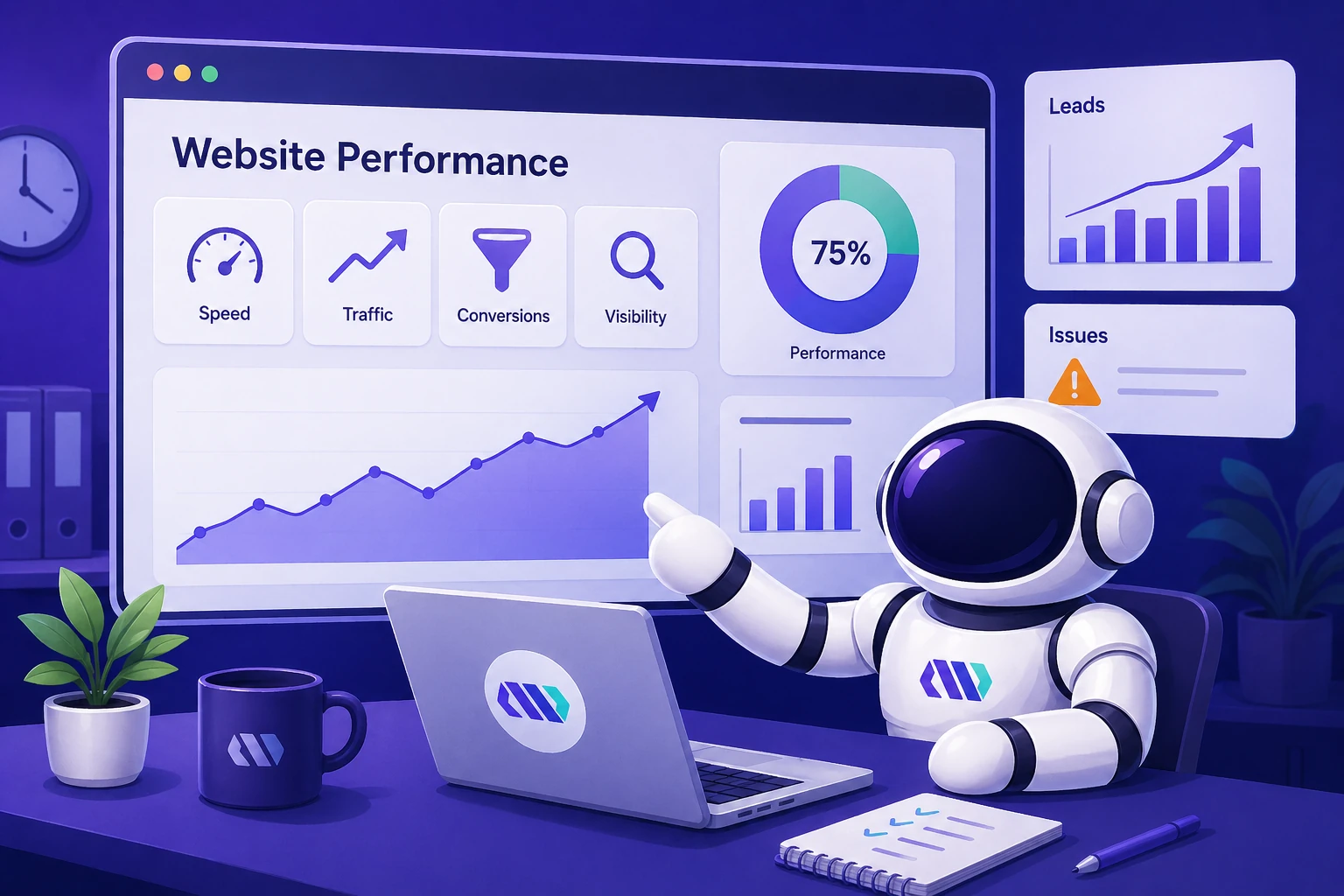
Aesthetics often drive the initial investment in a website, but technical debt is what erodes its return over time. Many small and mid-sized businesses run on platforms burdened with plugins and unoptimized code. Google confirms that its ranking systems use Core Web Vitals, while stating that good scores do not guarantee the top position, since relevance comes first. A slow site therefore loses twice: it ranks with a handicap, and it frustrates the visitors who do arrive. For a tech startup in Santa Monica, a sluggish site is more than a technical glitch, because it signals a lack of rigor to investors and enterprise clients.
Google measures page experience through three Core Web Vitals, which replaced First Input Delay with Interaction to Next Paint in March 2024. The table below gives the thresholds that Google considers good, measured at the 75th percentile of page loads.
| Metric | What it measures | Good threshold |
|---|---|---|
| Largest Contentful Paint (LCP) | Loading speed of the main content | 2.5 seconds or less |
| Interaction to Next Paint (INP) | Responsiveness to clicks and taps | 200 milliseconds or less |
| Cumulative Layout Shift (CLS) | Visual stability while the page loads | 0.1 or less |
Meeting these thresholds involves more than compressing images. High-performing sites rely on server-side rendering, edge delivery and lean front-end code so that content appears quickly wherever the visitor is located. A stable layout and immediate response to interactions act as a quiet trust signal and move the prospect closer to a request for proposal. The way high-performance web architecture increases B2B lead generation is detailed in a dedicated article.
Consider a local logistics provider whose clients check shipping data on the go: if the mobile interface is slow, they turn to a more responsive competitor. Custom development removes the weight of generic themes, which supports rankings and lowers the cost per lead.
The impact of infrastructure on conversion rates
Infrastructure is the foundation of digital sales, because an optimized backend removes the abandonments caused by errors and delays. Three areas show where custom architecture typically outperforms off-the-shelf solutions:
- Lean code execution: reducing the weight of JavaScript and CSS so that the browser's main thread stays available for the visitor.
- Caching strategies: combining server caching and content delivery networks (CDNs) to serve pages close to the user.
- Optimized database queries: making sure lead capture forms and search functions respond instantly, even under heavy traffic.
None of these optimizations is visible to the visitor, yet together they decide whether a prospect reaches the contact form or leaves on the second page. This is why the choice between custom native code and a CMS deserves a business discussion rather than a purely technical one.
The shift from keyword volume to conversion intent
The traditional SEO playbook of chasing high-volume, generic keywords has lost much of its value. Many searches now end on the results page itself, because the answer is displayed there, which means a large share of informational traffic never reaches your site. To capture actual leads, your strategy must move toward bottom-of-funnel keywords that signal a readiness to buy. This means identifying the specific problems your audience faces, such as regulatory compliance hurdles or scalability issues, and positioning your services as the answer to them.
Instead of targeting "Los Angeles marketing agency", for example, a specialized firm might target "B2B lead generation for aerospace manufacturers in California". This focused approach attracts a smaller but far more qualified audience. By aligning your content with the search intent of decision-makers who are ready to sign, you stop spending resources on casual visitors and concentrate on the prospects who generate revenue. The approach requires a precise understanding of your ideal customer profile and of the words these buyers use when they look for a partner, which is where an experienced SEO services team makes the difference.
Lead generation also depends on an information architecture that guides the visitor toward a specific action. A reader who lands on a blog post should find a natural link to a related case study, and then to a consultation form. When the site behaves like a well-trained sales representative, the return on organic traffic becomes much easier to measure.
Establishing authority through proprietary insights
Google describes its quality expectations through E-E-A-T (experience, expertise, authoritativeness and trust) and states that trust is the most important of the four. E-E-A-T is not a ranking factor in itself, but Google's systems use signals that help identify content demonstrating these qualities. For a B2B company, the most convincing proof is first-hand experience that a language model cannot invent, which is best expressed through documented case studies and original analysis. A report on trends in your sector or a detailed account of how you solved a technical challenge for a client creates a barrier that generic sites cannot cross.
Trust is the hardest asset to build online and the easiest to lose. Beyond testimonials, your site must display clear authority signals: verifiable references, transparent information about how you work and how you handle data, and the professional background of the leadership team. In a market where AI-generated personas are becoming common, authentic expertise from identifiable people is a strong differentiator that attracts better inquiries. Turning that expertise into clear, persuasive pages is the job of B2B web copywriting.
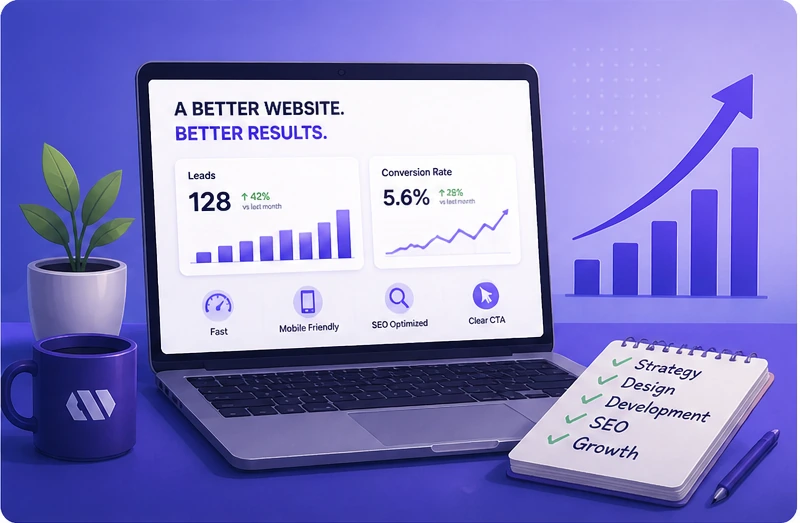
A manufacturing company in the South Bay, for instance, may not care about digital transformation in the abstract. It cares about how your solution reduced production downtime for a comparable plant, with figures to support the claim. By leading with concrete outcomes, you meet the search engine's expectation of expert content and answer the prospect's most pressing question at the same time. This alignment between SEO requirements and sales enablement is what distinguishes a high-performing digital strategy.
Advanced lead capture and user journey optimization
Many B2B websites lose leads because their call to action is either too aggressive or too hidden. A modern lead capture strategy recognizes that most visitors are not ready to buy on their first visit. A tiered approach works better: a soft call to action, such as an industry guide, for early-stage prospects, and a direct one, such as a meeting request, for buyers who are ready to talk. This structure respects the longer sales cycles typical of US professional services.
Contact forms deserve the same attention. Every field you add is one more reason for a busy executive to abandon the form, so the first contact should ask only for what you need to reply. Progressive profiling then collects additional information over later interactions, and behavioral triggers, such as offering a relevant resource when a visitor is about to leave, recover part of the traffic that would otherwise be lost.
Mobile conversion completes the picture. Many executives run their first research on a smartphone between two meetings, so lead forms must be easy to complete on a small screen, with click-to-call buttons and a simplified navigation.
Lead generation best practices in 2026
Turning traffic into revenue requires a strict focus on what the visitor needs at each step. Three practices stand out among the companies that convert well:
- Interactive assessments: quizzes or ROI calculators that deliver immediate value while qualifying the lead.
- Content personalization: adjusting the homepage message to the visitor's industry or previous interactions.
- Real-time engagement: an AI assistant that answers technical questions and books meetings outside office hours.
These tools only work on pages that load fast and express a clear offer.
Frequently asked questions about lead performance
The same three questions come up in almost every conversation with founders whose website is not getting leads. The answers below summarize the points developed in this article.
Why did my organic lead volume drop after recent search updates?
Search engines increasingly reward content that brings original information and first-hand expertise. If your pages say what dozens of other pages already say, their visibility suffers, and AI Overviews now answer many simple questions directly on the results page. Technical performance also matters, since Core Web Vitals are part of the signals used by Google's ranking systems.
How does custom web development improve my SEO?
Custom development produces clean code without the weight of themes and plugins. The result is faster pages, easier crawling for search engines and precise structured data that helps AI-driven search understand your business and services. Our guide on structuring data for Google's AI search summaries explains how to implement it.
What is the most effective way to capture B2B leads today?
The most effective method is to publish valuable, ungated content that proves your expertise, followed by a low-friction call to action. This builds trust before you ask for personal information. For high-intent traffic, keep contact forms short and make sure your value proposition is clear within the first seconds on the page.
Modernize your digital presence for scalable ROI
As search engines summarize more answers themselves, the gap between websites that demonstrate expertise and those that repeat generic content will keep widening. Your website should therefore be treated as a strategic asset that requires ongoing optimization rather than a one-off project.
Custom development and an expert-led SEO strategy give a small business a durable foundation, built on speed, authority and search intent. The next step is to identify where your funnel loses prospects, from the first search to the contact form, and to correct those points in order of impact.
- vote(s)